A Journey Shaped by History, Not Just Distance
Traveling from Évora to Seville can become far more than a transfer between two remarkable cities. A route through Estremoz, Elvas, Mérida and Zafra connects the Alentejo with Spanish Extremadura before turning south into Andalusia. Along the way, the landscape shifts from cork oak country and marble towns to broad agricultural plains and the approaches to Seville.
This is a deliberate sightseeing route, not the shortest road south. Its appeal lies in the sequence: Roman Évora, medieval Estremoz, fortified Elvas, imperial Mérida and the trading squares of Zafra, followed by Seville’s layered architecture.
For the Portugal portion and the onward journey into Spain, you travel in the same private car with the same fluent, knowledgeable English-speaking driver. That continuity makes luggage, hotel departures and the cross-border transition easier, while historical context shared during the drive helps connect the places you visit.
Évora: Begin Within the Old Walls
Allow Évora a proper visit before departure. Its UNESCO-listed historic center brings together Roman remains, medieval religious architecture and streets shaped by centuries of urban life. Starting here gives the journey a strong historical foundation rather than an early rush toward the border.
The Roman Temple is the clearest surviving statement of the city’s ancient importance. Its columns rise above the surrounding square, close to the cathedral and former ecclesiastical buildings. Although often associated with Diana in popular accounts, that identification is not established.
Nearby, the cathedral’s substantial granite exterior introduces a different chapter of Évora’s past. Continue toward Praça do Giraldo, where arcades and café terraces make a comfortable place to pause between monuments.
The Church of São Francisco and its Chapel of Bones offer another perspective on the city’s religious history. If you prefer more time outdoors, follow the quieter streets toward the Aqueduto da Água de Prata, where later buildings fit around its arches. Comfortable shoes matter on Évora’s uneven paving.
Estremoz: Marble Streets and a Hilltop Skyline
Northeast of Évora, Estremoz makes a rewarding first stop in the Alentejo. The surrounding district is known for marble, and the stone appears throughout the town in façades, paving and architectural details. Look closely and the connection between landscape and building material becomes unusually tangible.
The town has two distinct settings. Below, the broad Rossio Marquês de Pombal provides an open introduction to everyday Estremoz. Above it, the older fortified quarter climbs toward the castle and its prominent marble keep.
A walk through the upper streets reveals whitewashed houses, stone doorways and stretches of defensive wall. From suitable viewpoints, the countryside opens beyond the town, with cultivated land extending toward the horizon.
Estremoz works best as an unhurried walking stop rather than a rapid photograph break. The climb to the castle area involves gradients and uneven surfaces, so decide whether you want to explore both levels or concentrate on one. It is also a sensible place to pause for lunch before continuing east.
Elvas: Reading the Border Through Its Fortifications
Near the Spanish frontier, Elvas changes the architectural scale of the journey. Its UNESCO-listed defensive ensemble reflects the strategic importance of protecting Portugal’s eastern border. Rather than relying only on medieval walls, the city developed an extensive system of bastioned fortifications suited to artillery warfare.
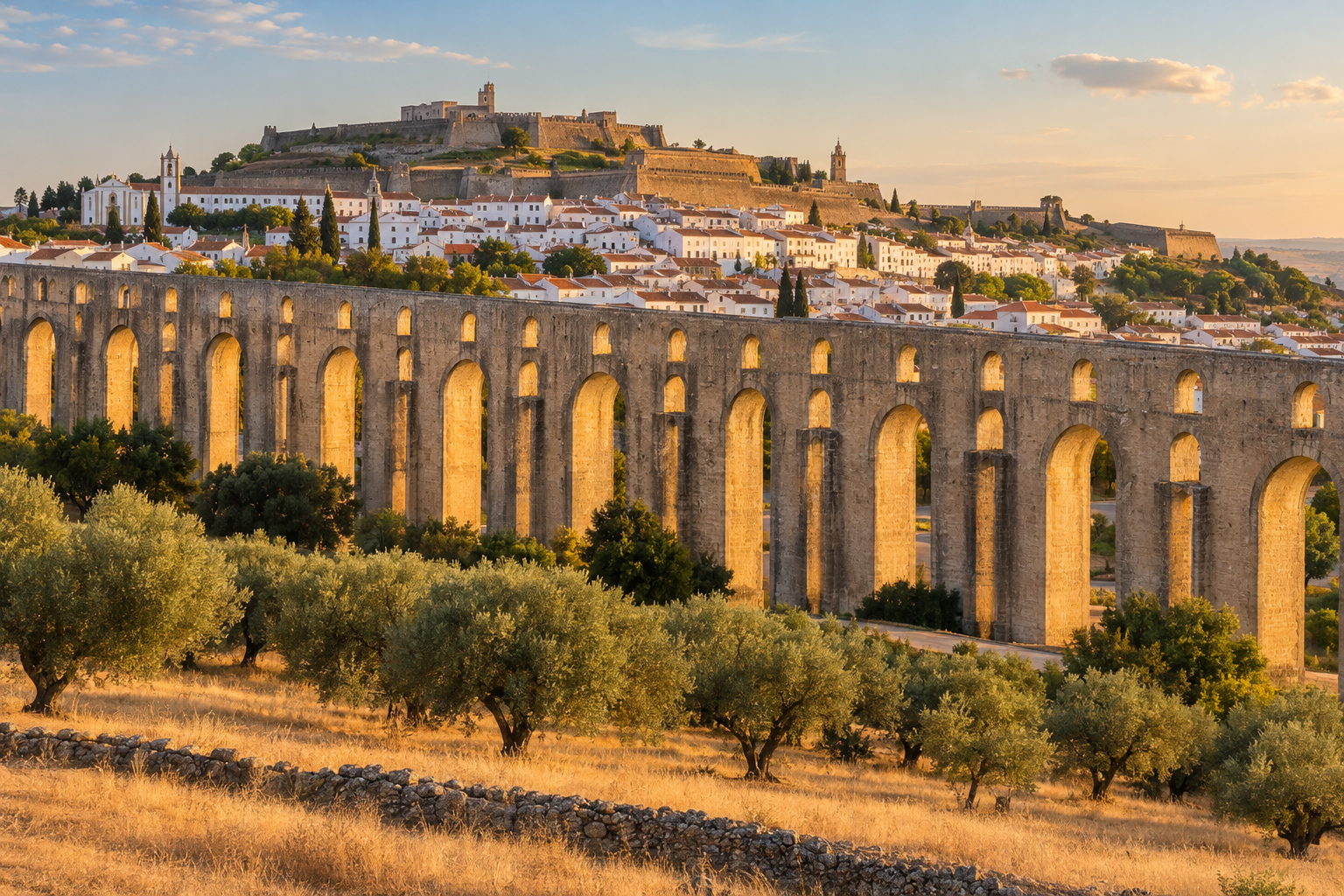
The Amoreira Aqueduct creates a striking arrival, its tall arcades stretching across the landscape outside the center. Within the walls, streets lead toward Praça da República and the former cathedral, while the castle occupies higher ground.
To understand Elvas fully, consider the relationship between the walled city and its outlying forts. The Fort of Graça stands on a separate hill and offers a particularly clear sense of how military architecture responded to terrain. Interior visits depend on current access arrangements.
Here, a private car with a fluent, knowledgeable English-speaking driver is especially useful: the aqueduct, historic center and outlying defenses are spread across different locations. You can focus your walking on the places that interest you most rather than treating every connection as a hike.
Let us take you there, privately
Your own Mercedes-Benz and fluent English-speaking driver, on your schedule.
Request a private quoteMérida: A Substantial Roman Stop in Spain
Crossing into Spain brings you into Extremadura, not yet Andalusia. Continuing to Mérida adds distance, but it also introduces one of the journey’s strongest historical destinations. Founded as Augusta Emerita under Emperor Augustus, the city became an important center of Roman Lusitania.
The Roman theater and neighboring amphitheater deserve dedicated time. Their contrasting forms reveal different aspects of public entertainment: staged performance in one, arena spectacles in the other. These are substantial archaeological sites, so avoid squeezing them between a late lunch and a fixed evening arrival.
Elsewhere, the Temple of Diana stands within the modern city, while the long Roman bridge crosses the Guadiana. The river setting offers a welcome outdoor counterpoint to the monument visits.
Choose your priorities rather than trying to cover every Roman remnant in one afternoon:
- The theater and amphitheater for major archaeological monuments.
- The Temple of Diana for ancient architecture within everyday streets.
- The Roman bridge and riverside for a more open-air walk.
An overnight stay makes Mérida much more rewarding than a hurried detour.
Zafra: Trading Squares and a Ducal Palace
From Mérida, the route turns south toward Zafra. Its compact historic center offers a gentler rhythm after the scale of the Roman sites, with connected squares, arcaded edges and streets that invite a relatively short, focused walk.
Plaza Grande and Plaza Chica form the heart of the visit. Their proportions and covered walkways recall Zafra’s long commercial role, while the surrounding streets preserve the feel of a town organized around exchange and public gathering.
The imposing Alcázar of the Dukes of Feria adds a different dimension. Built as a noble residence with a fortress-like exterior, it now houses a Parador hotel. Its towers remain a defining feature of the townscape; do not assume that all interior spaces are open to casual visitors.
Zafra is a natural place for a relaxed break before the final drive to Seville. A square-side pause and a walk through the old center can be enough, particularly if you have already devoted the morning to Mérida.
Arriving in Seville and Setting the Right Pace
Seville provides a rich conclusion: the cathedral and Giralda, the Real Alcázar and the streets of Santa Cruz bring the journey into the history of Islamic and Christian Andalusia. Give these landmarks their own time after arrival rather than treating them as one last stop on a long driving day.
For the full route, consider three travel days after your stay in Évora. Spend the first exploring Estremoz and Elvas, the second continuing to Mérida for its Roman monuments, and the third traveling through Zafra to Seville. With less time, select fewer stops rather than compressing everything into a single day.
Mainland Spain is one hour ahead of Portugal, an important detail when planning admission times and hotel arrivals. Summer heat also favors earlier walks and longer midday breaks.
Portugal Magik coordinates the journey in a black Mercedes-Benz E-Class, V-Class or Sprinter, according to your party’s needs. Your fluent, knowledgeable English-speaking driver handles the road connections and arrival logistics throughout, while you retain time to explore monuments on foot. Admission arrangements should be checked separately, especially for Seville’s major sights.
Let us take you there, privately
Your own Mercedes-Benz and fluent English-speaking driver, on your schedule.
Request a private quoteGood to know
Is this the shortest route from Évora to Seville?
No. Traveling through Estremoz, Elvas, Mérida and Zafra is a history-focused itinerary that adds distance. It is best enjoyed over several days, or shortened by choosing fewer stops.
Will we have the same car and driver in Portugal and Spain?
Yes. This journey is framed around the same private car and the same fluent, knowledgeable English-speaking driver throughout the Portugal portion and onward into Spain.
How much time should we allow for the historic stops?
Consider three travel days after your stay in Évora for the full route, allowing meaningful time in Elvas and Mérida. Plan additional time in Seville for its major monuments.
Does the time change when crossing from Portugal into Spain?
Yes. Mainland Spain is one hour ahead of Portugal. Account for this when arranging monument admissions, meal breaks and hotel arrivals.
Let us take you there, privately
Your own Mercedes-Benz and fluent English-speaking driver, on your schedule.
Request a private quoteSignature Journeys
Prefer a ready-made private itinerary?
See our signature journeys, starting from €2,950