Day 1: Begin Beside the Douro in Porto
Porto makes a memorable starting point for a journey south. Granite churches rise above steep streets, tiled facades catch the changing light, and the Douro gives the historic center its sense of direction. Spend your first day here rather than immediately setting off for another city.
Begin near the cathedral, whose elevated position helps you understand Porto’s geography, then walk downhill toward Ribeira. This riverfront quarter rewards an unhurried approach: narrow passages, old merchant buildings and views toward the warehouses of Vila Nova de Gaia across the water.
The Dom Luís I Bridge offers another perspective on the city. Its upper level carries pedestrians and the Metro, with broad views along the river. Expect slopes and uneven paving throughout the historic center, and choose comfortable shoes rather than trying to cover every landmark.
Your Portugal portion is part of one continuous journey: the same private car and fluent, knowledgeable English-speaking driver stay with you from Porto through Southern Spain. With Portugal Magik handling the driving and transfer logistics, you can settle into the route without changing transport arrangements at the border.
Stay overnight in Porto. Ideally, arrive the previous evening so this first day can be devoted to the city.
Day 2: Follow the Route South Through Coimbra to Lisbon
Leave Porto after breakfast and make Coimbra your principal stop before continuing to Lisbon. This is a substantial travel day, so give Coimbra a clear focus rather than adding several smaller detours.
The university occupies the high ground above the Mondego River, and its historic buildings are part of a UNESCO World Heritage property. The university precinct, the surrounding lanes and the exterior of the Romanesque Old Cathedral give you a strong introduction to the city’s academic and religious history.
If the Joanina Library is a priority, check admission arrangements ahead of time. Access is controlled, and a visit should be planned around an available entry time rather than assumed on arrival. Otherwise, concentrate on the upper town and leave room for a relaxed lunch before the onward drive.
Arrive in Lisbon later in the day and keep the evening simple. A short walk through Baixa toward Praça do Comércio provides a satisfying first encounter with the capital, ending at the broad waterfront beside the Tagus.
Stay overnight in Lisbon, with a second night here to avoid unnecessary packing.
Day 3: Explore Lisbon’s Riverfront and Historic Hills
Give Lisbon a full day. Its distances can look modest on a map, but steep streets and widely separated monuments make a selective plan much more enjoyable than an exhaustive checklist.
Start in Belém, where the Jerónimos Monastery reflects the wealth and ambition of Portugal’s maritime expansion. Its Manueline architecture combines elaborate carved ornament with religious and royal imagery. Nearby, the Belém Tower stands beside the Tagus, once part of the defenses of the river approach.
Choose your interior visits according to current access arrangements, then leave time simply to walk along the river. Belém is best appreciated as a district, not just a pair of monuments to photograph.
Later, return toward central Lisbon for Alfama and a viewpoint such as Santa Luzia. The contrast is striking: open waterfront spaces give way to close-set houses, stairways and glimpses of the estuary between rooftops.
Your fluent, knowledgeable English-speaking driver can connect these separate districts and share historical context during the journey, while you explore pedestrian streets on foot. Agreeing practical meeting points helps reduce unnecessary uphill walking without suggesting that every old lane is accessible by car.
Let us take you there, privately
Your own Mercedes-Benz and fluent English-speaking driver, on your schedule.
Request a private quoteDay 4: Cross the Alentejo to Évora and Seville
Today links Portugal with Andalusia, passing through the Alentejo before crossing into Spain. It is the longest transfer day in this itinerary, and Évora should be a focused stop rather than a full sightseeing day.
Inside its historic walls, Évora brings several periods of Portuguese history into close proximity. The Roman Temple stands near the cathedral, while whitewashed streets open onto squares bordered by arcades and traditional buildings. Walk between the temple area and Praça do Giraldo for a compact introduction to the city.
The surrounding landscape is equally important to the experience. Cork oaks, pasture and broad horizons distinguish this part of Portugal from the greener countryside around Porto. Let the journey itself contribute to your understanding of the country.
A sensible plan is to:
- Depart Lisbon early enough for a meaningful stop in Évora.
- Choose one interior visit at most, allowing for lunch and walking.
- Continue to Seville without adding another major sightseeing stop.
Mainland Spain is one hour ahead of Portugal, so account for the clock change when considering your arrival. Spend the evening settling into Seville rather than arranging a demanding program.
Day 5: Spend a Full Day in Seville
Seville deserves the full day you have preserved for it. Its most important monuments lie close together, but each has enough historical depth to reward time and attention.
The cathedral occupies the site of the city’s former principal mosque. The Giralda preserves much of the earlier minaret beneath its later Renaissance bell tower, making the building a particularly clear expression of Seville’s changing history.
Nearby, the Real Alcázar brings together palace architecture, courtyards and gardens shaped by successive rulers. The palace associated with Pedro I is especially celebrated for its Mudéjar craftsmanship. Reserve admission ahead where appropriate, and avoid scheduling the cathedral and Alcázar so tightly that one visit feels rushed.
Between monuments, walk through Santa Cruz, where narrow lanes and small squares offer a more intimate sense of the city. Later, consider Plaza de España and neighboring María Luisa Park for a change of scale and a greener setting.
In warmer months, place the most exposed walking earlier or later in the day. Seville’s summer heat is a practical reason to leave space for breaks, not an invitation to add more stops.
Stay a second night in Seville.
Let us take you there, privately
Your own Mercedes-Benz and fluent English-speaking driver, on your schedule.
Request a private quoteDay 6: Continue to Córdoba and the Guadalquivir
Travel east to Córdoba and devote the afternoon to its historic center. Staying overnight allows you to appreciate the city beyond a brief stop between Seville and Granada.
The Mosque-Cathedral is the essential visit. Its repeated arches and columns reveal the scale and architectural ambition of the medieval mosque, while the cathedral inserted within it expresses the building’s later Christian history. Check current visiting arrangements and allow enough time to absorb these contrasting spaces.
Outside, walk through the old Jewish quarter and toward the Roman Bridge. The bridge has been altered and rebuilt over the centuries, but its position across the Guadalquivir still provides one of Córdoba’s defining views.
Keep the remainder of the day flexible. Courtyards are an important part of Córdoba’s architectural character, although individual patios are not universally open to visitors throughout the year. The lanes, squares and riverfront provide plenty to explore without relying on access to private properties.
Day 7: Finish Among Granada’s Palaces and Hills
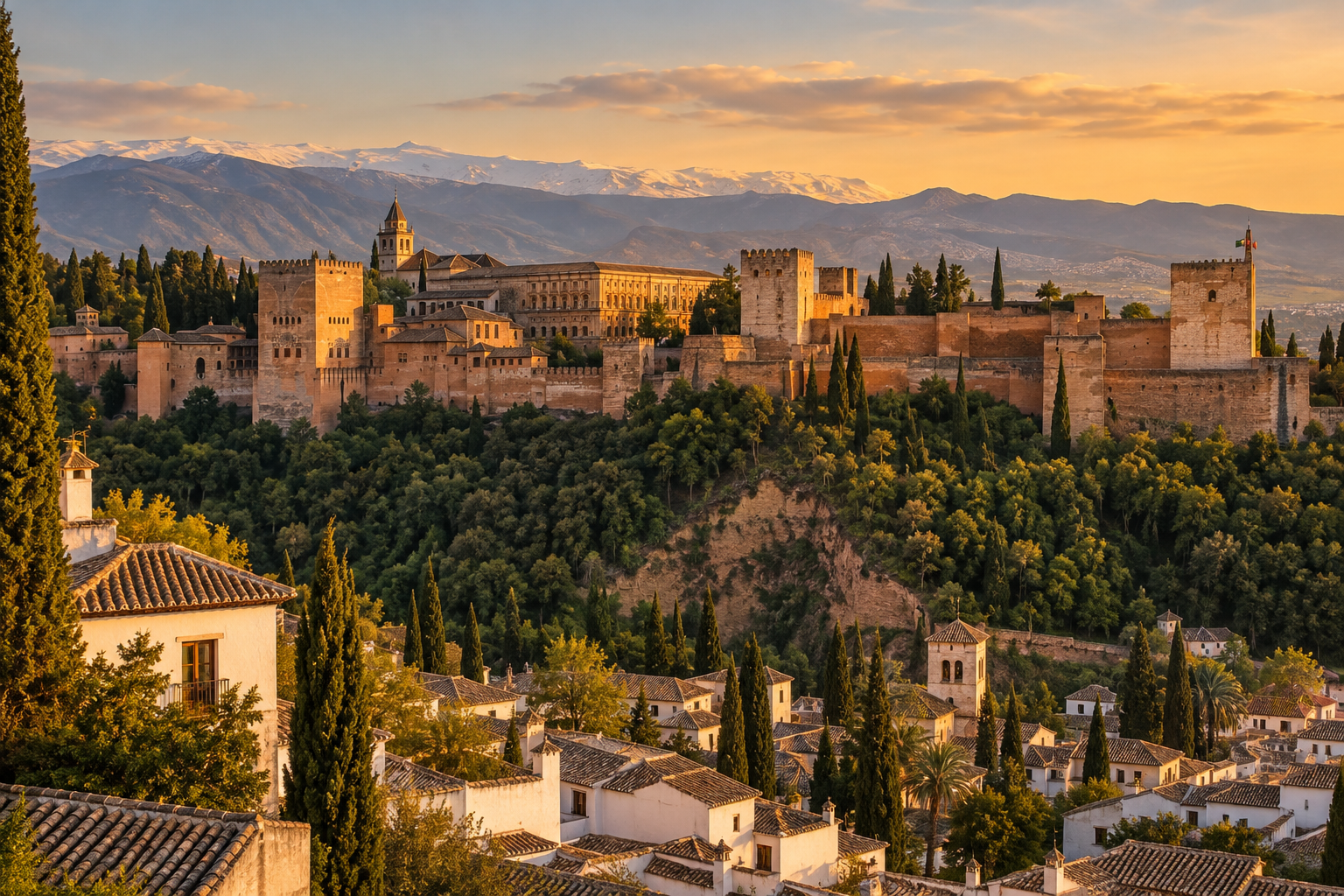
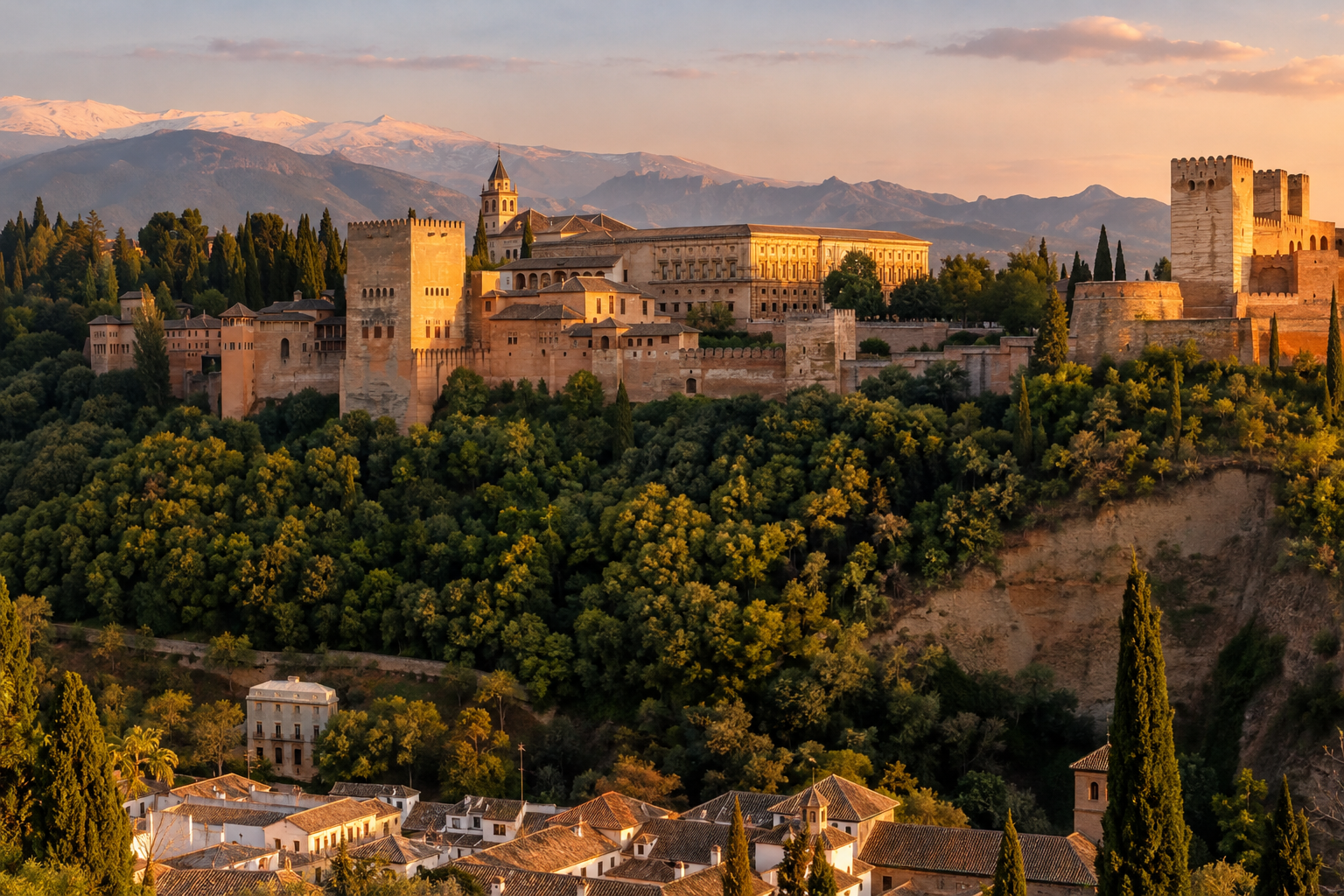
Leave Córdoba for Granada, where the landscape becomes a fitting finale to the journey. The Alhambra rises above the city, with the Sierra Nevada forming part of the wider mountain setting.
Make the Alhambra and Generalife your principal objective, but organize this day around confirmed admission. Access to the Nasrid Palaces requires the appropriate ticket and a specific entry time. Availability should shape the itinerary before the journey is finalized, not become a last-minute assumption.
If timing permits, explore part of the Albaicín afterward. Its sloping lanes and viewpoints reveal the relationship between the old residential quarter and the Alhambra across the valley. Mirador de San Nicolás is a celebrated vantage point, though it can be busy.
Throughout the seven days, your fluent, knowledgeable English-speaking driver handles the road journey and shares context between destinations. Portugal Magik can match your party with a black Mercedes-Benz E-Class, V-Class or Sprinter, keeping the same vehicle throughout the Portugal and Southern Spain itinerary.
Plan to sleep in Granada tonight rather than force in a departure transfer. Seven days offers a rewarding introduction to both countries, but an additional night would give Granada the breathing room it deserves.
Good to know
Can you travel from Porto to Southern Spain in seven days?
Yes, provided you keep the route selective and accept several substantial driving days. This itinerary includes Porto, Coimbra, Lisbon, Évora, Seville, Córdoba and Granada, with Coimbra and Évora treated as stops rather than overnight stays.
Does the same private car stay with you in Portugal and Spain?
This journey is planned with the same private car and fluent, knowledgeable English-speaking driver throughout, from Porto through Portugal and onward into Southern Spain.
Which monument should you book first?
Prioritize the Alhambra, particularly admission that includes the Nasrid Palaces. Its availability and timed entry should help determine your Granada schedule. Check admission arrangements for Seville’s major monuments and Coimbra’s Joanina Library as well.
When is a comfortable time for this itinerary?
Spring and autumn generally offer more comfortable conditions for walking than midsummer, especially in inland Andalusia. Weather varies, so bring layers for Porto and plan outdoor sightseeing around the forecast.
Let us take you there, privately
Your own Mercedes-Benz and fluent English-speaking driver, on your schedule.
Request a private quoteSignature Journeys
Prefer a ready-made private itinerary?
See our signature journeys, starting from €2,950