Granada Begins with Its Geography
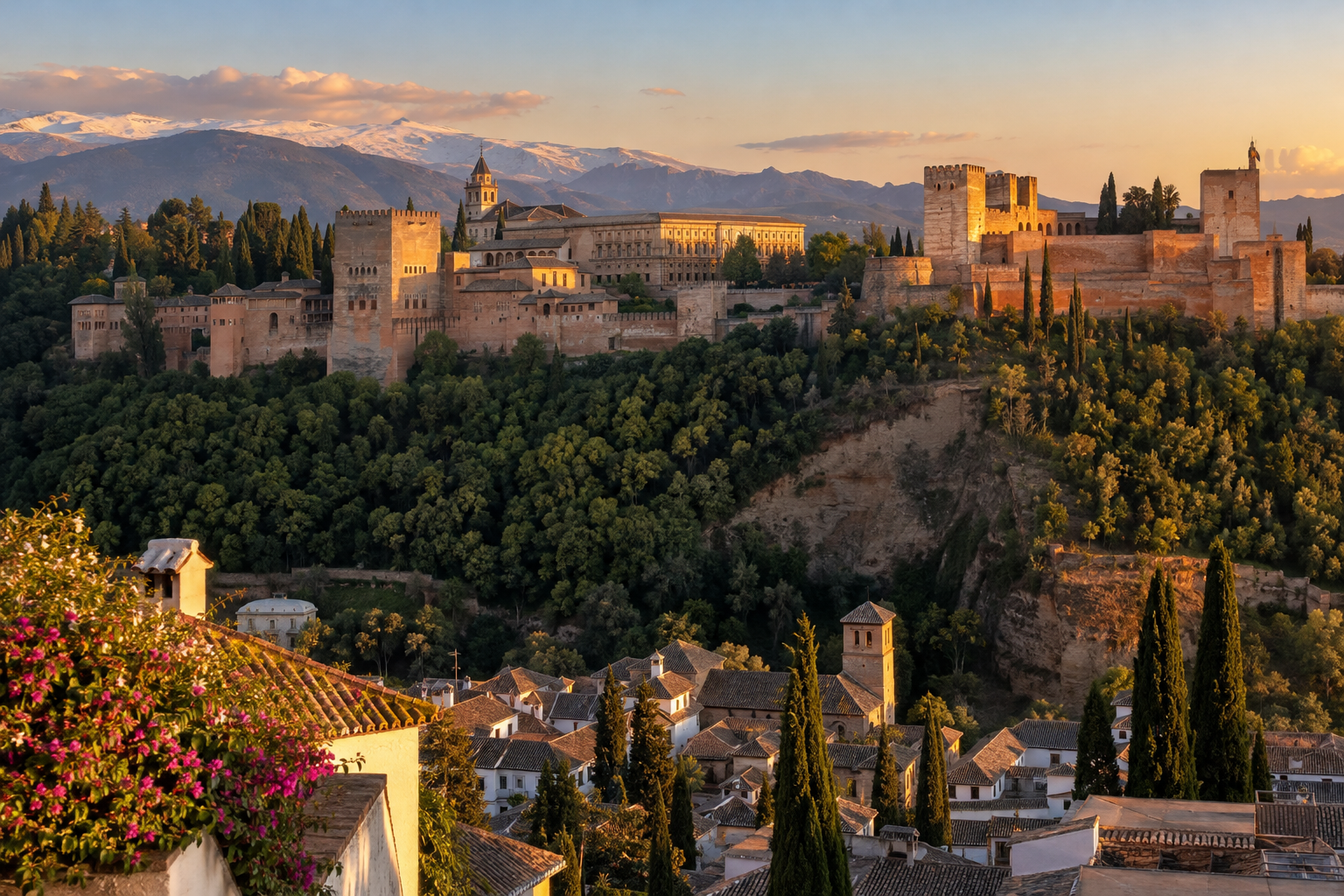
Granada’s monuments make more sense when you understand the landscape around them. The Alhambra occupies a wooded hill above the Darro River, facing the historic Albaicín quarter. Below these heights, the city center opens into streets and squares shaped by centuries of Islamic and Christian rule.
For your first visit, concentrate on three areas: the Alhambra and Generalife, the cathedral district, and the route from Plaza Nueva into the Albaicín. Together, they offer a rewarding introduction without turning your day into a checklist.
The distances on a map can be deceptive. Hills, stone paving and pedestrian streets make walking slower than you might expect, particularly in warm weather. A private driver helps by coordinating practical arrival and collection points, leaving your energy for the monuments and viewpoints rather than navigation and parking.
If your schedule allows, give Granada more than a single rushed day. The Alhambra deserves sustained attention, while the lower city and hillside neighborhoods reward a separate, unhurried walk.
The Alhambra and Generalife: Your First Priority
The Alhambra is Granada’s essential monument, but it is not simply one palace. It is a fortified complex of palaces, courtyards, gardens and defensive structures, with much of its most celebrated architecture dating to the Nasrid dynasty, the last Muslim dynasty to rule Granada.
Within the Nasrid Palaces, the contrast between restrained exterior walls and intricate interiors is part of the experience. Look closely at carved plasterwork, geometric tile decoration and inscriptions. Water gives the courtyards their structure and atmosphere, especially around the long reflecting pool in the Court of the Myrtles and the fountain in the Court of the Lions.
The Alcazaba introduces a different aspect of the site. Its towers and walls speak to the Alhambra’s defensive purpose, while elevated views help you understand its position above the city. Some sections involve steps and exposed ground, so consider your comfort with climbing before including every viewpoint.
The Palace of Charles V adds a striking Renaissance counterpoint. Its monumental square exterior encloses a circular courtyard, a useful reminder that the Alhambra continued to change after the Christian conquest of Granada in 1492.
Across the complex, the Generalife offers gardens and the former summer retreat of the Nasrid rulers. Its planted terraces, water channels and views back toward the Alhambra provide a gentler conclusion to a substantial visit.
Reserve through authorized channels well ahead, and check exactly what your ticket includes. Access to the Nasrid Palaces follows a specified admission time. Your private driver can plan the journey around that reservation, but tickets and entry conditions remain subject to the monument’s rules.
Let us take you there, privately
Your own Mercedes-Benz and fluent English-speaking driver, on your schedule.
Request a private quoteThe Cathedral and Royal Chapel: Granada’s Royal Legacy
Down in the city center, Granada Cathedral and the Royal Chapel tell the story of the city after 1492. They stand close together, making this one of the most satisfying areas to explore on foot.
The cathedral is a major expression of Spanish Renaissance architecture, although its long construction history brought together different architectural approaches. Inside, the scale is immediately apparent: tall columns, broad spaces and the great main chapel create a very different atmosphere from the intimate courtyards of the Nasrid Palaces.
Beside it, the Royal Chapel holds the tombs of Queen Isabella I of Castile and King Ferdinand II of Aragon. Joanna I and Philip I are also buried here. The chapel’s late Gothic character and royal funerary monuments make it an important stop for understanding Granada’s place in Spanish history.
Treat the cathedral and chapel as separate visits rather than assuming one admission covers both. As religious sites, they may also have access arrangements affected by worship or special occasions.
Nearby, the Alcaicería occupies the area associated with Granada’s historic silk market. The lanes you see today were largely rebuilt after a nineteenth-century fire, so they should not be mistaken for an intact medieval bazaar. Even so, their compact layout offers an atmospheric transition between the cathedral and the surrounding commercial streets.
Plaza Bib-Rambla and Plaza Nueva: Squares with Purpose
Granada’s squares are worth your time because they connect the major sights while giving you room to pause. Two are especially useful on a first visit, though their characters are quite different.
Plaza Bib-Rambla, close to the cathedral, is the natural place to slow down after an interior visit. The Fountain of the Giants anchors the square, while cafés and surrounding facades give it an enclosed, sociable feel. Sit for a coffee and let the cathedral district become a place you experience rather than simply pass through.
Plaza Nueva sits at the meeting point of the lower city and the routes toward the Alhambra and Albaicín. Despite its name, meaning “New Square,” it is a historic urban space. The imposing Royal Chancery building reflects Granada’s importance as a center of royal justice after the conquest.
At the eastern end, the Church of Santa Ana introduces the architecture of the river corridor. Its brickwork and tower belong to Granada’s Mudéjar tradition, in which Islamic-derived craftsmanship continued under Christian patronage.
For a short central walk, these stops work particularly well together:
- Plaza Bib-Rambla for a relaxed pause near the cathedral.
- The cathedral and Royal Chapel for architecture and royal history.
- Plaza Nueva for the transition toward the Darro and hillside quarters.
Along the Darro and Up into the Albaicín
From Plaza Nueva, follow the Carrera del Darro beside the river. Historic buildings, stone bridges and glimpses of the Alhambra above make this one of Granada’s most rewarding walking routes. The street is narrow, and you should stay alert to vehicles where permitted.
Along the way, El Bañuelo preserves an important medieval Islamic bathhouse. Its chambers and star-shaped openings offer a more intimate encounter with the city’s Islamic heritage than the scale of the Alhambra allows. Check current admission arrangements before relying on a visit.
Continue toward the Paseo de los Tristes, a riverside space with a particularly memorable view of the Alhambra’s walls and towers. It is a good place to appreciate how dramatically the fortress rises above the valley.
The Albaicín climbs away from the river through steep lanes and small squares. At the Mirador de San Nicolás, the Alhambra appears across the valley, with the Sierra Nevada beyond when visibility allows. Sunset attracts crowds, so an earlier visit may suit you better if you prefer more room to look around.
Plaza Larga offers another side of the neighborhood: a small square connected to everyday local life, near the historic Arco de las Pesas gateway. The walk between these places is part of the appeal, but uneven surfaces and gradients deserve consideration.
Choose a Thoughtful Route, Not Every Monument
If you have additional time, the Monastery of San Jerónimo offers an important Renaissance church and an elaborate interior. Farther from the main walking circuit, the Monastery of La Cartuja is particularly notable for its richly decorated Baroque spaces. Choose one if you enjoy religious architecture rather than trying to squeeze both into an already full day.
For a balanced stay, devote one substantial part of your itinerary to the Alhambra and Generalife, then another to the cathedral district and Albaicín. Leave room between them for lunch and a proper rest.
Portugal Magik can organize your Granada visit as part of a private day tour or a multi-day Andalusia journey, with an English-speaking driver and a black Mercedes-Benz E-Class, V-Class or Sprinter. Private transport simplifies the journeys between your hotel and suitable access points, while the historic quarters remain places to discover largely on foot.
The best Granada itinerary gives its greatest monuments the attention they deserve and leaves its squares enough time to become part of your memory of the city.
Let us take you there, privately
Your own Mercedes-Benz and fluent English-speaking driver, on your schedule.
Request a private quoteGood to know
Which Granada monuments should you prioritize on a first visit?
Start with the Alhambra and Generalife, then visit Granada Cathedral and the Royal Chapel. A walk through the Albaicín adds historic streets and viewpoints overlooking the Alhambra.
Do you need to reserve Alhambra tickets in advance?
Advance booking through authorized channels is strongly recommended. Check your ticket inclusions carefully, and plan around the specified admission time for the Nasrid Palaces.
Which Granada squares are most worth visiting?
Plaza Bib-Rambla is ideal for a pause near the cathedral, Plaza Nueva connects the center with the Darro valley, and Plaza Larga offers a different perspective on the Albaicín.
Can you explore Granada entirely by private car?
No. Many historic streets are pedestrianized, narrow or subject to access restrictions. Private transport helps with arrivals and transfers, but walking is essential for much of the historic center and Albaicín.
Let us take you there, privately
Your own Mercedes-Benz and fluent English-speaking driver, on your schedule.
Request a private quoteSignature Journeys
Prefer a ready-made private itinerary?
See our signature journeys, starting from €2,950