Understanding Ronda Before You Start Walking
Ronda is often introduced through a single view: the Puente Nuevo spanning the deep gorge of the Guadalevín River. It is a remarkable sight, but the bridge becomes more meaningful when you explore the streets on either side. Ronda is not simply a monument with a town around it. Its neighborhoods reveal successive chapters of settlement, defense, trade and everyday life.
For a first visit, think in terms of three main areas. La Ciudad, south of the gorge, contains the historic core associated with Islamic Ronda and its later Christian transformation. El Mercadillo, to the north, developed beyond that older enclosure and now holds many of the town’s busiest shopping streets. Farther south, San Francisco sits outside the old defensive gateway.
The distances between major sights are manageable, but the terrain deserves respect. Some streets are cobbled, and routes toward the lower bridges involve significant slopes. A private English-speaking driver (fluent and knowledgeable) makes arrival easier by handling the road journey and coordinating practical drop-off and pickup points, leaving you to enjoy the neighborhoods on foot.
La Ciudad: Quiet Streets Beyond the Puente Nuevo
Crossing the Puente Nuevo from the northern side brings you into La Ciudad. Completed in the late 18th century, the bridge is comparatively recent beside the history of the settlement it connects. Pause at the designated viewpoints, then continue away from the busiest stretch to appreciate the older quarter’s smaller scale.
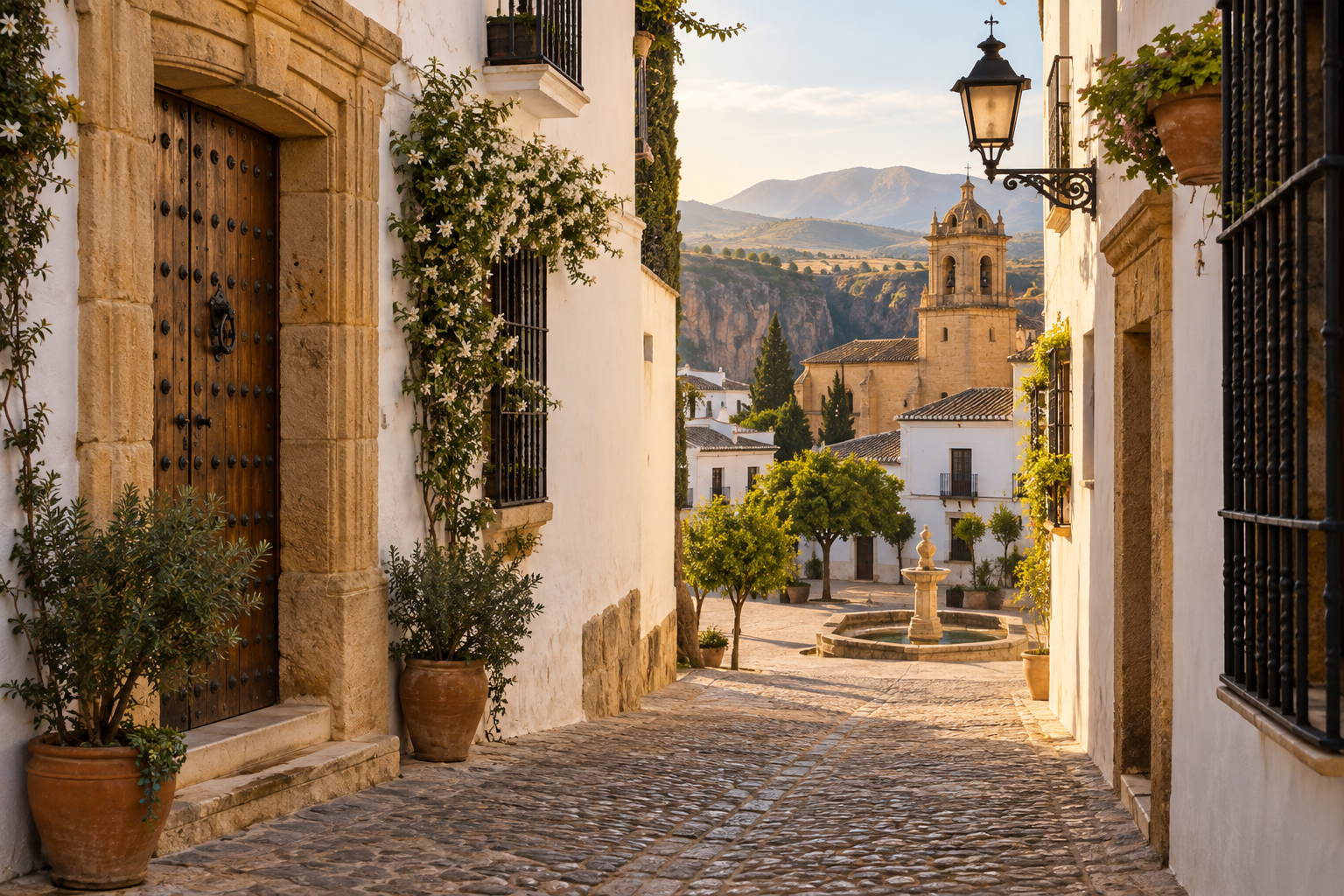
Here, the pleasure lies in the transitions. A narrow lane opens into a square. A plain wall gives way to a carved doorway. The gorge disappears from view, replaced by stone facades and enclosed streets that feel quite different from Ronda’s exposed cliff edges.
Make your way toward Plaza de María Auxiliadora. This is a rewarding place to pause, with views toward the surrounding countryside and the landscape below the old town. You do not need to descend into the gorge to appreciate how dramatically Ronda occupies its rocky setting.
Nearby, the Palacio de Mondragón offers another layer of history. Its architecture reflects different periods, and it houses Ronda’s municipal museum. If you choose to enter, its courtyards and gardens complement the walk outside. Check current access arrangements rather than building your entire route around an assumed opening time.
Give this neighborhood room in your schedule. La Ciudad is best experienced as a sequence of streets and spaces, not a race between photographed landmarks.
Around Plaza Duquesa de Parcent: Ronda’s Monumental Heart
Within La Ciudad, Plaza Duquesa de Parcent deserves a slower circuit. Trees, substantial civic buildings and the Church of Santa María la Mayor give the square a more settled atmosphere than the busy bridge approaches. It is an excellent place to understand how Ronda’s religious and administrative center changed after the Christian conquest in 1485.
Santa María la Mayor occupies the site of the former principal mosque. Its architecture reflects a long building history, including Gothic and Renaissance elements. Even if you remain outside, the church’s distinctive profile and relationship to the square make it an essential stop.
The town hall also faces the plaza. Together, these buildings give you a sense of the square as a place of civic life rather than merely a scenic pause. Walk around its edges before choosing somewhere to sit, since the changing angles reveal different relationships between the church, trees and surrounding facades.
From here, explore the adjoining lanes without feeling obliged to enter every monument. Much of Ronda’s character is visible at street level:
- Stone door surrounds and historic coats of arms.
- Irregular corners shaped by older street patterns.
- Small stretches of shade between sunlit squares.
- Views that briefly open toward the hills beyond town.
This is a particularly satisfying part of the walk if your interests lean toward architecture and the history of urban places.
Let us take you there, privately
Your own Mercedes-Benz and fluent English-speaking driver, on your schedule.
Request a private quoteSan Francisco: Beyond the Medieval Gateway
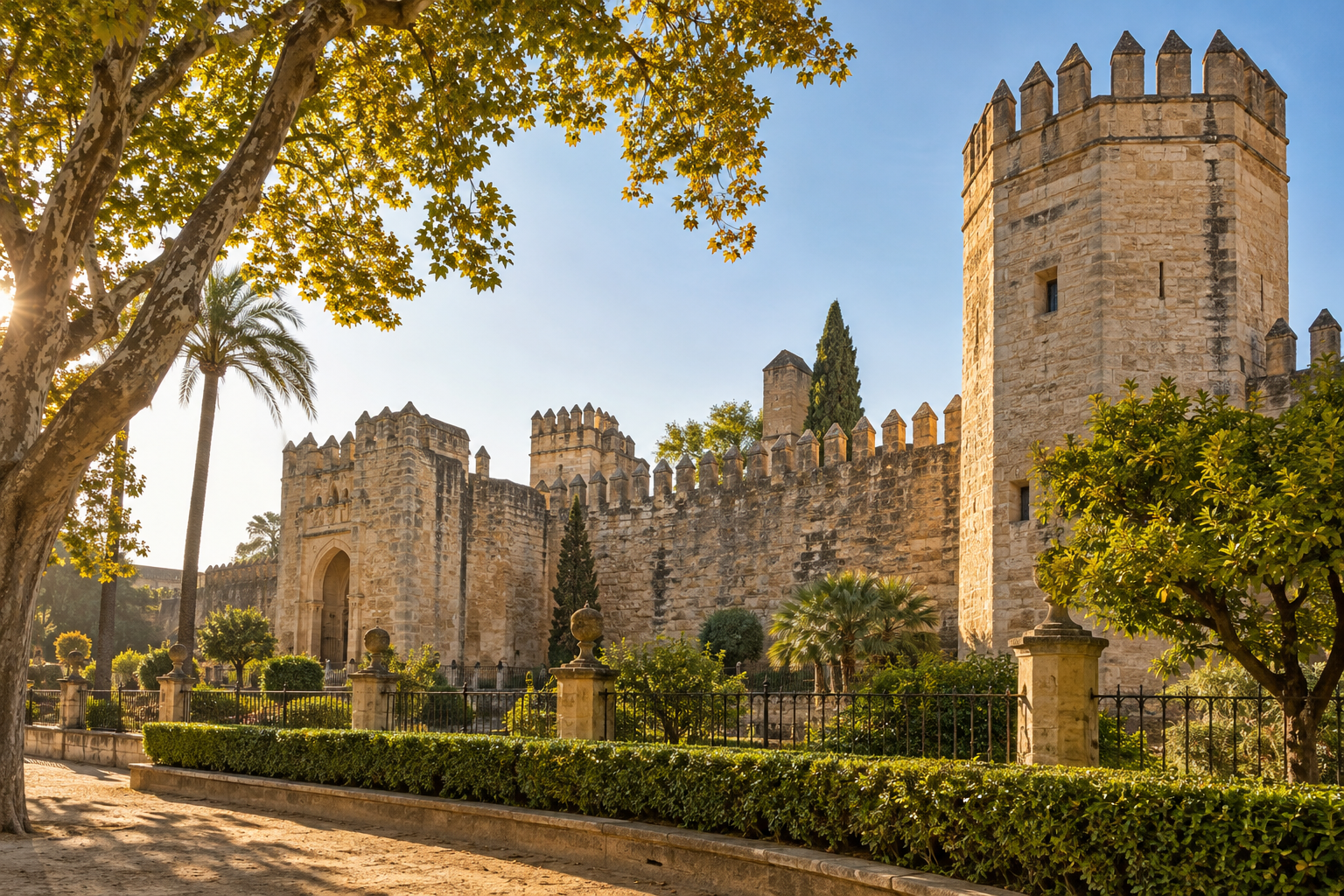
Continue south from the monumental center toward the Puerta de Almocábar. This medieval gateway formed part of Ronda’s defenses and remains one of the clearest places to picture the boundary between the enclosed town and the settlement beyond it.
Take time to look at the gateway together with the adjoining walls. Seen in isolation, a stone entrance can seem simply picturesque. Seen as part of the defensive circuit, it explains how movement into the town was controlled and how strongly the landscape influenced its protection.
Outside lies the San Francisco neighborhood. The atmosphere changes here: the streets feel less concentrated around major visitor sights, and the open space near the gateway offers a welcome contrast to the narrow lanes of La Ciudad. Restaurants and everyday neighborhood activity make this a sensible area for a lunch pause, depending on your timing.
San Francisco rewards a modest detour rather than an ambitious checklist. Walk a few streets beyond the walls, return toward the gateway, and notice how the older town rises behind it. You gain a different impression of Ronda when you approach it from outside its defenses rather than from the famous bridge.
If you plan to continue toward the lower historic quarter afterward, allow for uneven surfaces and changes in elevation. The shortest-looking route on a map is not always the gentlest walk.
The Lower Bridges and San Miguel: Ronda at a Different Level
The streets around the lower bridges reveal a Ronda that many hurried visits overlook. Near the Puente Viejo and the historic San Miguel area, you move away from the high, sweeping panorama and closer to the terrain that shaped the town’s early approaches.
The Arab Baths are a principal attraction here. Dating from the Islamic period, they preserve important elements of a medieval bath complex, including vaulted chambers with star-shaped roof openings. Their position near a historic entrance to town helps explain their relationship to movement, water and urban life.
Visiting this area involves a descent, and the return uphill can feel demanding in warm weather. Wear shoes with reliable grip and carry water. If you prefer a gentler outing, prioritize the upper neighborhoods rather than treating the lower quarter as compulsory.
On the northern side of the gorge, the Jardines de Cuenca occupy a series of terraces with changing views across the chasm. Their steps and slopes make them more than a flat garden stroll, but they offer a valuable alternative perspective on the bridge and cliffside buildings.
A private English-speaking driver (fluent and knowledgeable) can help you plan a realistic walking sequence and coordinate pickup at a suitable accessible location. That flexibility is especially useful when your party has different levels of comfort with hills.
El Mercadillo: Gardens, Shopping Streets and a Relaxed Finish
Return to the northern side of Ronda for El Mercadillo. Around Plaza de España and the streets leading away from the Puente Nuevo, the town feels busier and more outward-looking. This is a useful counterpoint to the enclosed lanes of La Ciudad.
The Plaza de Toros is one of Ronda’s defining historic buildings. Opened in 1785, it holds an important place in the town’s bullfighting history. You can appreciate its exterior as part of your walk, or consider the museum and arena visit if that history interests you, subject to current visitor arrangements.
Nearby, the Alameda del Tajo provides shaded paths and viewpoints over the surrounding landscape. After stone lanes and steep descents, its garden setting makes a comfortable place to slow down. Remain within designated viewing areas and take particular care near exposed edges when walking with children.
Finish along Carrera Espinel, commonly known as Calle de la Bola, for a sense of contemporary Ronda through its pedestrian shopping street. You need not walk its full length. A short stretch adds everyday town life to a visit otherwise dominated by monuments.
For an unhurried outing, choose La Ciudad, San Francisco and El Mercadillo as your core, adding the lower bridges only if time and energy allow. Portugal Magik can arrange your private journey in a black Mercedes-Benz with an English-speaking driver (fluent and knowledgeable), handling transport logistics and sharing historical context during the drive. You arrive ready to explore, with the return journey already considered.
Let us take you there, privately
Your own Mercedes-Benz and fluent English-speaking driver, on your schedule.
Request a private quoteGood to know
Which Ronda neighborhoods are best for exploring on foot?
Start with La Ciudad for historic lanes and monuments, El Mercadillo for gardens and shopping streets, and San Francisco for the medieval gateway and a more residential atmosphere.
Is walking around Ronda strenuous?
You can explore much of the upper town without descending to the lower bridges, although cobbles and some slopes remain. Routes to the Arab Baths and through the Jardines de Cuenca involve more demanding changes in elevation.
Can you enjoy Ronda without walking down into the gorge?
Yes. The Puente Nuevo area, upper viewpoints and Alameda del Tajo offer impressive perspectives without requiring a descent. La Ciudad also provides plenty of architectural interest away from the gorge.
How does private transport help with a walking visit to Ronda?
An English-speaking driver (fluent and knowledgeable) handles the journey to Ronda and coordinates suitable drop-off and pickup locations. You explore pedestrian areas on foot without needing to organize parking or the onward drive.
Let us take you there, privately
Your own Mercedes-Benz and fluent English-speaking driver, on your schedule.
Request a private quoteSignature Journeys
Prefer a ready-made private itinerary?
See our signature journeys, starting from €2,950