Start with Carmona’s Hilltop Setting
Before you study Carmona’s monuments, take a moment to understand its position. Set on a ridge above the agricultural plains east of Seville, the town occupies a naturally commanding site. Its elevation helps explain why successive civilizations fortified it, settled here and reshaped what earlier inhabitants had built.
Carmona was an important Roman town, known as Carmo, and later developed under Islamic rule. Ferdinand III of Castile captured it in 1247. Rather than replacing one historical identity with another, these changes left buildings and streets that carry evidence of several periods at once.
That is the key to a rewarding first visit. A gateway may contain ancient masonry beneath medieval additions. A church may preserve part of an earlier mosque. A quiet square may occupy ground central to town life for centuries.
The historic center rewards walking, but its slopes, stone paving and distances between sights deserve some planning. A private driver can make the approach easier, coordinating suitable drop-off points and arranging the outlying Roman archaeological site around your time in the old town.
Think of Carmona as three connected landscapes: the fortified entrances, the inhabited town within them, and the ancient burial grounds outside its walls.
Puerta de Sevilla: Read the Town’s Defenses
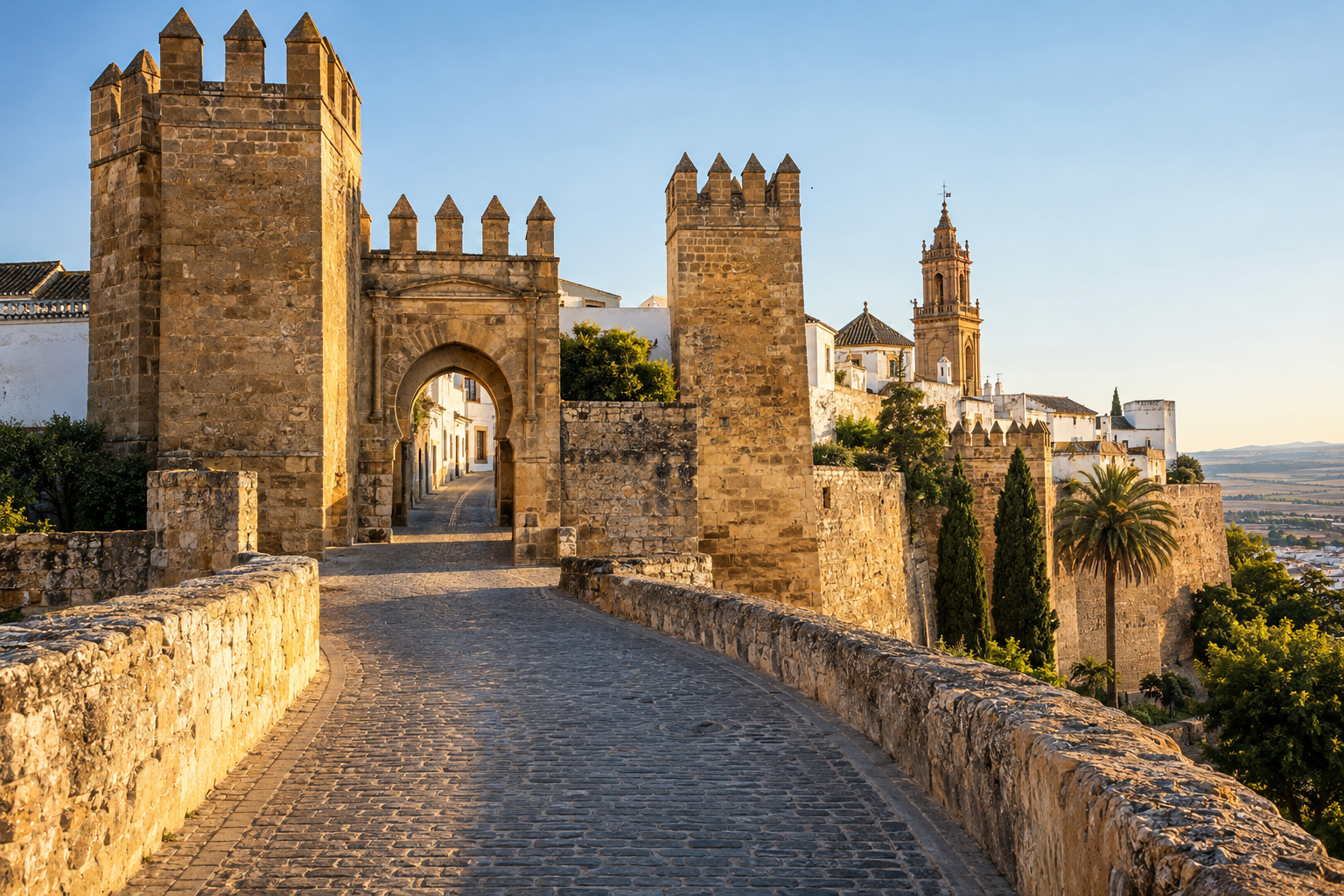
The Alcázar de la Puerta de Sevilla is the best place to begin understanding Carmona’s defensive history. This is not simply an ornamental entrance. The gateway forms part of a substantial fortified complex, built and adapted across different periods to protect an important approach to the town.
Its origins reach back into antiquity, with major Roman work and later Islamic and Christian alterations. The mass of the structure is immediately striking: heavy masonry, high walls and a passage that makes the act of entering the old town feel deliberate.
Look at the relationship between the gate and the fortification above it. Defenders needed more than a barrier at street level. They also needed height, visibility and a strong position from which to control movement below.
Where visitor access permits, the upper areas offer useful views over Carmona’s roofs. These help you see how the church towers, compact streets and surrounding countryside fit together.
Three details deserve your attention:
- The depth of the gateway, which emphasizes its defensive purpose.
- The changing masonry, evidence of repeated construction and adaptation.
- The contrast between the enclosed entrance and the open views above.
Begin here, and the rest of Carmona becomes easier to interpret.
Let us take you there, privately
Your own Mercedes-Benz and fluent English-speaking driver, on your schedule.
Request a private quoteSan Pedro and Santa María: Two Different Church Stories
Near the Puerta de Sevilla, the Church of San Pedro provides one of Carmona’s most recognizable landmarks. Its bell tower is commonly called the Giraldilla because of its resemblance to Seville’s Giralda. That comparison is useful, but the church also deserves attention as part of Carmona’s own architectural history.
San Pedro stands outside the principal gateway, reminding you that the town’s development was not confined to its fortified core. Its tower is a helpful visual reference as you approach or leave the historic center.
Inside the old town, the Priory Church of Santa María de la Asunción tells a different story. Built on the site of the former main mosque, it is principally a late Gothic church. The surviving Patio de los Naranjos preserves an important connection with the earlier Islamic complex.
Together, the courtyard and church illustrate both continuity of place and a profound change in religious architecture. Notice the contrast between the courtyard’s openness and the height and structure of the church interior.
If the buildings are open to visitors, allow time to look rather than simply step inside. Religious services and local arrangements may affect access, so keep your sightseeing sequence flexible.
Plaza de San Fernando: Understand the Living Town
Between the major monuments, Carmona’s streets explain how the historic center still functions as a town. Plaza de San Fernando is a particularly useful pause, a civic meeting place surrounded by buildings from different periods and connected to the streets you will use between landmarks.
The square occupies the area traditionally associated with the Roman forum. What you see today is not an intact Roman public space, but its central role helps you understand the persistence of urban life on the same ground.
Look for the Mudéjar house on the square, recognizable for architectural details reflecting Islamic artistic traditions within the later Christian town. It offers a valuable counterpoint to the large defensive and religious monuments: Carmona’s heritage also survives in domestic buildings.
From here, walk slowly toward Santa María and the eastern side of the old town. Whitewashed walls alternate with stone doorways, barred windows and substantial courtyard houses. Some facades are restrained, making their proportions and carved entrances more revealing than elaborate decoration would be.
You do not need to identify every building. Instead, notice the streets themselves: their narrowness, changes of direction and occasional opening into small squares. These spaces connect Carmona’s celebrated landmarks to its everyday life.
Puerta de Córdoba and the Upper Fortress
On the eastern side of Carmona, the Puerta de Córdoba marks another historic entrance. Its Roman origins are important, although the appearance you see today also reflects substantial later remodeling, particularly in the neoclassical period.
This distinction matters. Carmona’s monuments are rarely untouched survivals from a single age. The gate is best understood as an ancient piece of urban infrastructure repeatedly adapted to later needs and tastes.
Its position also draws your attention outward. Beyond the town lies the broad agricultural landscape of the Campiña, a reminder that Carmona’s importance depended on its relationship with the surrounding countryside as well as its defenses.
Higher up, the remains of the Alcázar del Rey Don Pedro recall another chapter of fortified power. Associated with the medieval Castilian monarchy and Pedro I, the complex occupies a commanding position. The Parador de Carmona stands within this upper fortress setting, but the hotel should not be mistaken for a completely preserved medieval palace.
A private driver can help you sequence these eastern landmarks with the rest of your visit, reducing unnecessary backtracking while leaving you time to appreciate the views. Public access to particular spaces should always be checked locally.
Let us take you there, privately
Your own Mercedes-Benz and fluent English-speaking driver, on your schedule.
Request a private quoteThe Roman Necropolis: Finish Beyond the Walls
Carmona’s Roman necropolis offers a necessary change of perspective. Outside the historic center, this archaeological site introduces the people of ancient Carmo through their burial places rather than their gates or public buildings.
Roman burial grounds were generally placed beyond the inhabited town. Here, tombs cut into the rock reveal different approaches to funerary architecture and commemoration. Much of the cemetery dates to the early centuries of Roman imperial rule.
The Tomb of Servilia is especially notable for its scale and architectural ambition. The Tomb of the Elephant takes its modern name from a stone elephant sculpture found there. Interpretations of that structure’s original function have been debated, so it is worth distinguishing what survives physically from what archaeologists propose about its use.
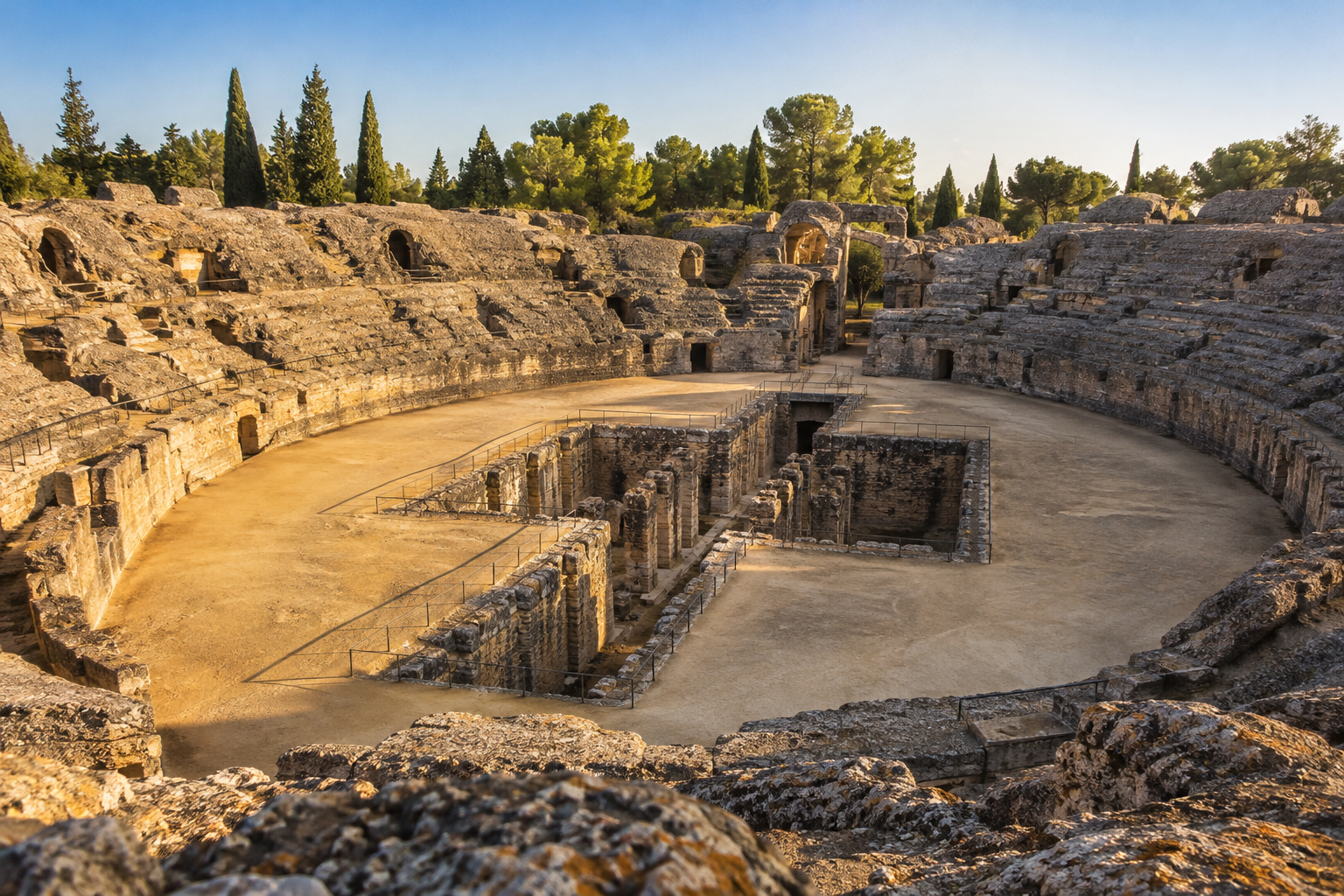
Nearby remains of the Roman amphitheater add another dimension to the ancient town, although access and viewing arrangements may differ from those of the necropolis.
Give this area unhurried attention. Uneven surfaces, exposed ground and warm weather can make it more demanding than a stroll through the shaded streets. Comfortable shoes, water and sun protection are sensible.
For a first visit, a private driver helps connect the archaeological site with Carmona’s gateways, churches and viewpoints. The result is a coherent understanding of the town: how it defended itself, worshipped, lived and remembered its dead.
Good to know
Which landmarks should you prioritize on a first visit to Carmona?
Start with the Alcázar de la Puerta de Sevilla, then explore Plaza de San Fernando and Santa María de la Asunción. Include the Puerta de Córdoba, the upper fortress setting and the Roman necropolis for a broader understanding of the town.
Can you explore Carmona’s historic center on foot?
Much of the historic center is best explored on foot, but expect slopes and stone paving. The Roman necropolis lies outside the old town, so planning transport between areas can make your visit more comfortable.
Why is Carmona’s Roman necropolis important?
Its rock-cut tombs preserve evidence of funerary architecture and burial customs in ancient Carmo. It complements the town’s defensive monuments by showing how Roman inhabitants commemorated their dead.
Is Carmona suitable for a private day tour from Seville?
Yes. Carmona is well suited to a day visit from Seville. A private driver-guide can coordinate transportation and the sightseeing route, with the order of visits adjusted to local access arrangements and your walking preferences.
Let us take you there, privately
Your own Mercedes-Benz and fluent English-speaking driver, on your schedule.
Request a private quoteSignature Journeys
Prefer a ready-made private itinerary?
See our signature journeys, starting from €2,950