Begin with the Landscape That Shaped Granada
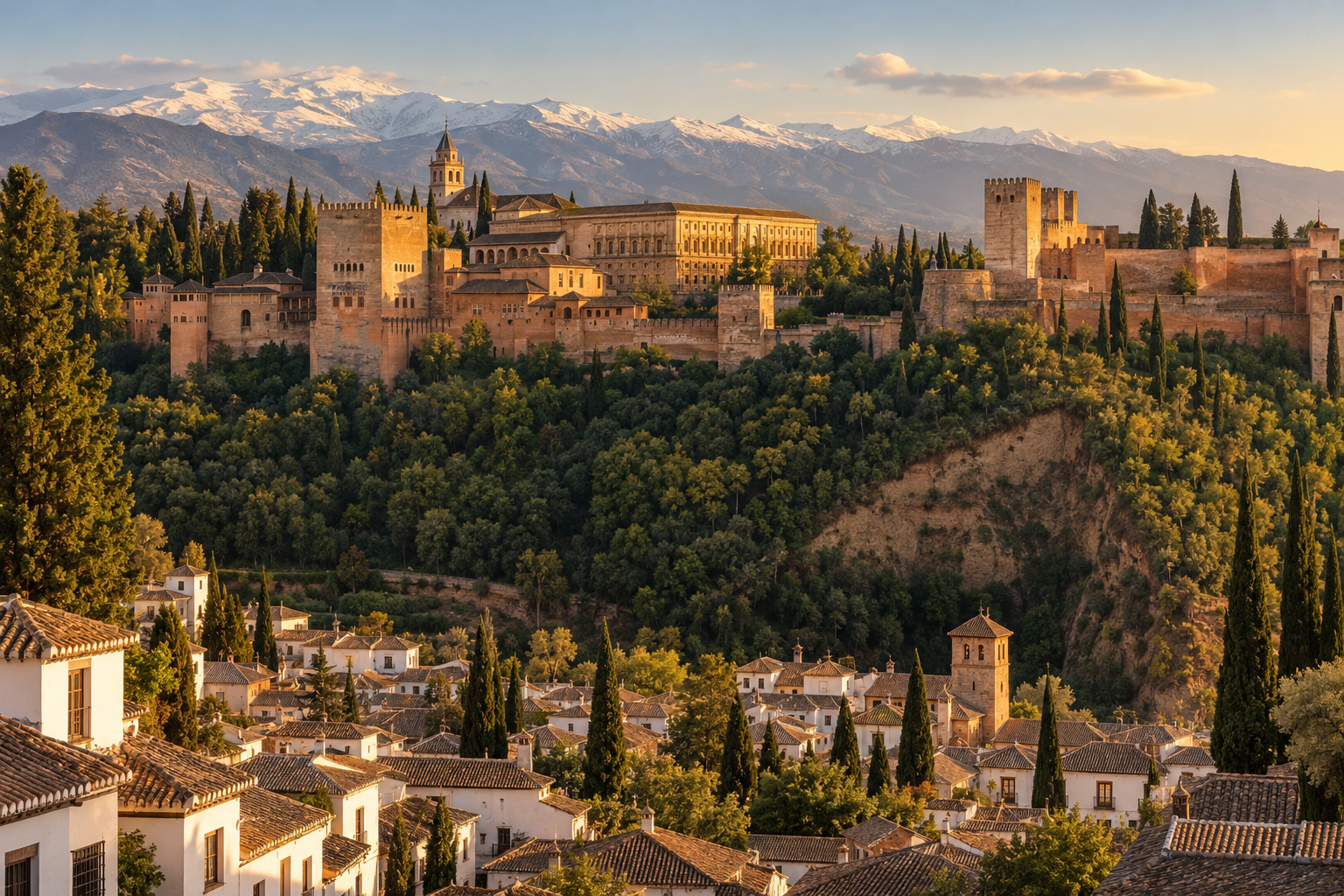
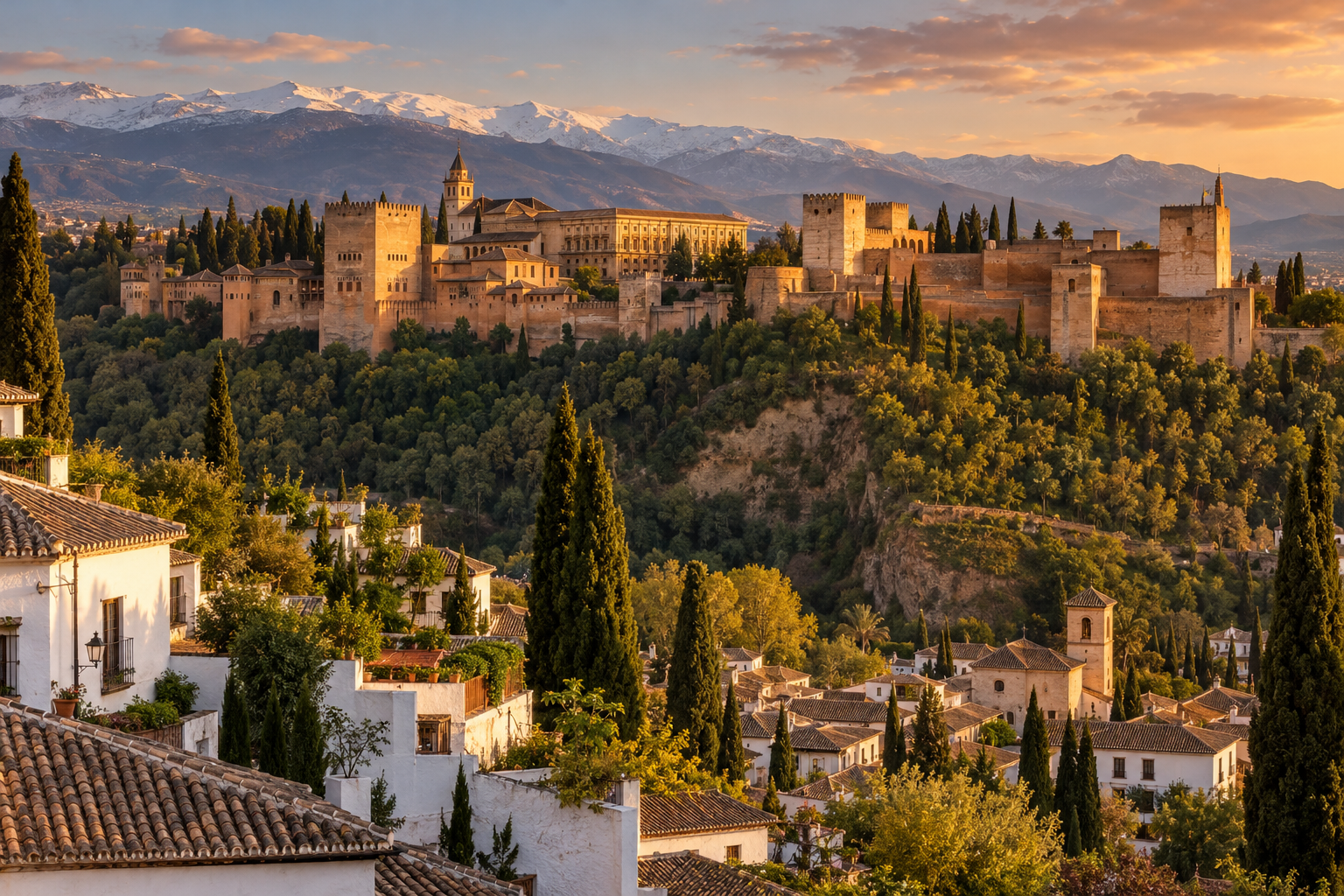
Before you look closely at Granada’s monuments, look at its setting. The Sierra Nevada rises beyond the city, while the Darro River runs through a narrow valley below the Alhambra. Opposite the palace hill, the Albaicín climbs in a dense arrangement of whitewashed houses, garden walls and winding streets.
This geography helps explain the city’s history. Elevated ground offered defensive advantages, water sustained gardens and households, and the fertile plain beyond the hills supported settlement. Granada’s beauty is inseparable from these practical foundations.
Although the area’s history reaches further back, the medieval city gained particular importance under the Zirid dynasty in the eleventh century. The Albaicín preserves traces of that period, including sections of defensive walls and gateways. Later, under the Nasrid dynasty, Granada became the capital of the last Muslim kingdom on the Iberian Peninsula.
For your walk, think of Granada as a series of historical layers rather than a checklist. The Alhambra introduces the Nasrid court, the Albaicín reveals the shape of the medieval city, and the lower center shows the changes that followed the Christian conquest in 1492.
The Alhambra: Architecture of a Nasrid Capital
The Alhambra occupies the Sabika hill, its walls and towers visible from much of historic Granada. Developed extensively by the Nasrid rulers from the thirteenth century onward, it was more than a royal residence. It was a fortified complex with palaces, administrative spaces, residences and areas supporting daily life.
Inside the Nasrid Palaces, history becomes intimate. Carved plaster, patterned tilework and Arabic inscriptions give rooms a richness that rewards slow observation. In the Court of the Myrtles, a long pool reflects the surrounding architecture. In the Court of the Lions, slender columns surround the celebrated fountain and its twelve stone lions.
These spaces expressed political authority as well as refinement. Architecture framed the ruler’s presence, while water, shade and carefully proportioned courtyards shaped the experience of moving through the palace.
The Alcazaba presents a different side of the complex. Its towers and defensive structures make the strategic value of the hill immediately clear. Across the grounds, the Generalife’s gardens and courtyards recall a royal retreat associated with cultivation, water and respite from court life. Their present appearance also reflects later changes.
Reserve your Alhambra admission well ahead, checking exactly which areas your ticket includes and any assigned entry time. A private English-speaking driver, fluent and knowledgeable, can make the approach easier by coordinating your arrival around that reservation and sharing historical context during the journey. You should still expect substantial walking within the complex.
Let us take you there, privately
Your own Mercedes-Benz and fluent English-speaking driver, on your schedule.
Request a private quoteAcross the Darro: Reading the Medieval City
Below the Alhambra, the Carrera del Darro follows the river past old buildings and stone bridges. The relationship between the water, steep slopes and fortress above gives this stretch an unusually clear sense of Granada’s historic setting.
One of its most revealing monuments is El Bañuelo, a surviving medieval Islamic bathhouse generally dated to the eleventh century. Its chambers and star-shaped roof openings offer a different perspective from the royal palaces. Here, the focus shifts toward the social practices and built environment of urban life.
Continue toward the Paseo de los Tristes, formally the Paseo del Padre Manjón. From this open riverside space, the Alhambra rises sharply overhead. The view emphasizes its defensive position more strongly than many distant panoramas do.
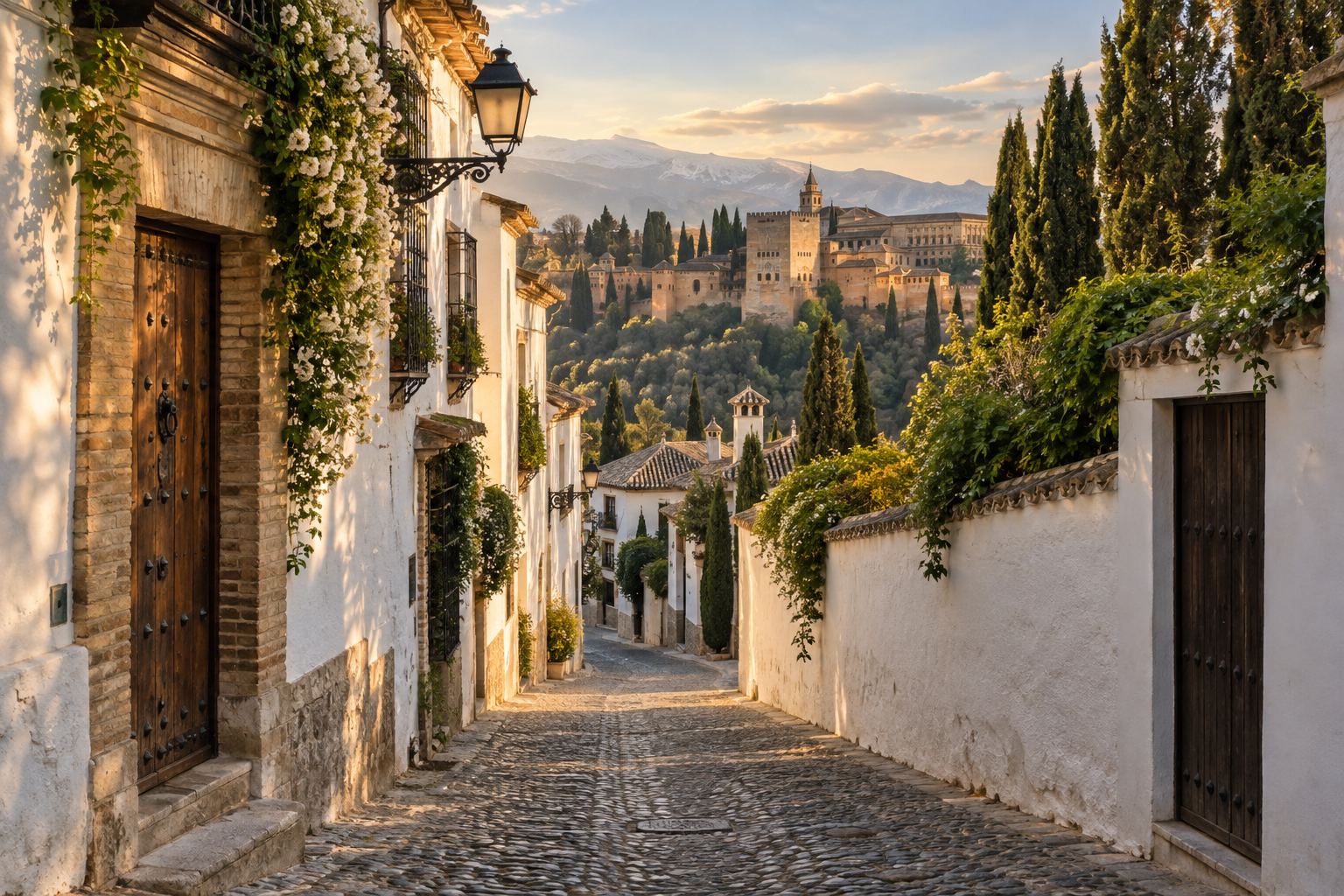
As you climb into the Albaicín, the route becomes part of the experience. Streets narrow, turn unexpectedly and open onto small squares. Cisterns recall the importance of storing and distributing water in a hillside neighborhood.
Notice three details as you walk:
- The surviving walls and gateways that marked earlier boundaries.
- The enclosed gardens of traditional houses known as cármenes.
- The way slopes and irregular streets shape views toward the opposite hill.
The Albaicín and Alhambra belong to the same UNESCO World Heritage property. Their connection is best understood by seeing both, not simply photographing one from the other.
1492 and the Transformation of Granada
The surrender of Granada to Isabella I of Castile and Ferdinand II of Aragon in 1492 ended Nasrid rule. It also began a profound transformation of the city’s religious institutions, architecture and population.
That transition was neither simple nor entirely visible in stone. Initial arrangements offered protections to the Muslim population, but these were progressively undermined. Forced conversion, repression and later expulsions changed Granada’s communities. As you move between medieval streets and Christian monuments, it is worth remembering that architectural continuity can conceal deep human rupture.
The Royal Chapel brings you directly to the monarchy associated with the conquest. Isabella and Ferdinand are buried here, alongside their daughter Joanna I and her husband Philip I. Its late Gothic architecture and royal tombs make it one of the clearest places to consider Granada’s importance to the emerging Spanish monarchy.
Nearby, the cathedral introduces another architectural language. Begun in the sixteenth century, it became a major expression of the Spanish Renaissance, particularly through the work of Diego de Siloé. Its scale and luminous interior contrast with the smaller, more enclosed spaces encountered earlier in the walk.
Allow time for both monuments rather than treating them as interchangeable. The chapel centers on dynasty and burial; the cathedral expresses a larger reordering of the city’s religious landscape.
Renaissance Ambition and the Memory of Commerce
The Renaissance also reached the Alhambra itself. The Palace of Charles V, begun in the sixteenth century, places a monumental classical building within the former Nasrid royal precinct. Its circular courtyard, enclosed by a square exterior, creates a striking contrast with the neighboring palaces.
This juxtaposition makes Granada particularly rewarding for travelers interested in history. You do not need to imagine one era replacing another completely. Here, different expressions of power stand almost side by side.
Back in the lower city, the Corral del Carbón opens another window onto Granada’s past. Built in the Nasrid period, it served as a funduq, providing accommodation and storage associated with trade. Its entrance and central courtyard bring commercial life into a story otherwise dominated by rulers and religious buildings.
Nearby, the Alcaicería recalls Granada’s historic silk market. The lanes you see today largely reflect rebuilding after a nineteenth-century fire, rather than an intact medieval bazaar. That distinction matters: the place preserves the memory and location of commerce, but not all its original fabric.
Together, these stops broaden your understanding of Granada beyond the palace walls. Merchants, travelers and working households also shaped the city you are exploring.
End with a View, and Leave Room for the Hills
Finish in the Albaicín if your energy allows. The Mirador de San Nicolás offers the celebrated view across to the Alhambra, with the Sierra Nevada beyond. It can be busy, especially toward sunset, but the panorama draws the day’s geography together: river valley, royal hill and surrounding mountains.
Granada is compact on a map, yet demanding on foot. Cobbles, gradients and stairs make comfortable shoes essential. In warmer months, plan exposed climbs for cooler parts of the day and leave room for breaks.
A private English-speaking driver, fluent and knowledgeable, can coordinate practical drop-off and collection points around pedestrian areas and restricted streets. This is especially useful when combining an Alhambra reservation with time in the lower city, although the oldest quarters still require walking.
For a fuller visit, spread this historical route over two days. Portugal Magik offers private day tours, multi-day private journeys and airport or city transfers in black Mercedes-Benz E-Class, V-Class and Sprinter vehicles. Your private English-speaking driver, fluent and knowledgeable, handles the driving and travel logistics, leaving you more time to explore Granada’s monuments at a considered pace.
Let us take you there, privately
Your own Mercedes-Benz and fluent English-speaking driver, on your schedule.
Request a private quoteGood to know
Can you explore Granada’s main historical sites in one day?
You can combine selected highlights in one day, but the Alhambra, Albaicín and cathedral area deserve generous time. Two days allow a more comfortable pace, particularly if you want to enter several monuments.
Should you reserve Alhambra tickets in advance?
Yes. Reserve well ahead and check which areas your admission includes. If your ticket includes the Nasrid Palaces, pay particular attention to the assigned entry time and current visitor requirements.
Is Granada’s historical center difficult to walk?
The lower center is generally easier to navigate than the hillside quarters. The Albaicín has steep streets, cobbles and stairs, while the Alhambra involves substantial walking. Choose your route according to your mobility and allow regular breaks.
How does private transport help with a Granada visit?
Private transport simplifies arrivals, onward travel and connections between suitable access points. Historic pedestrian areas and restricted streets still require walking, so drop-off and collection locations need to be planned accordingly.
Let us take you there, privately
Your own Mercedes-Benz and fluent English-speaking driver, on your schedule.
Request a private quoteSignature Journeys
Prefer a ready-made private itinerary?
See our signature journeys, starting from €2,950