Read Granada Through Its Old Streets
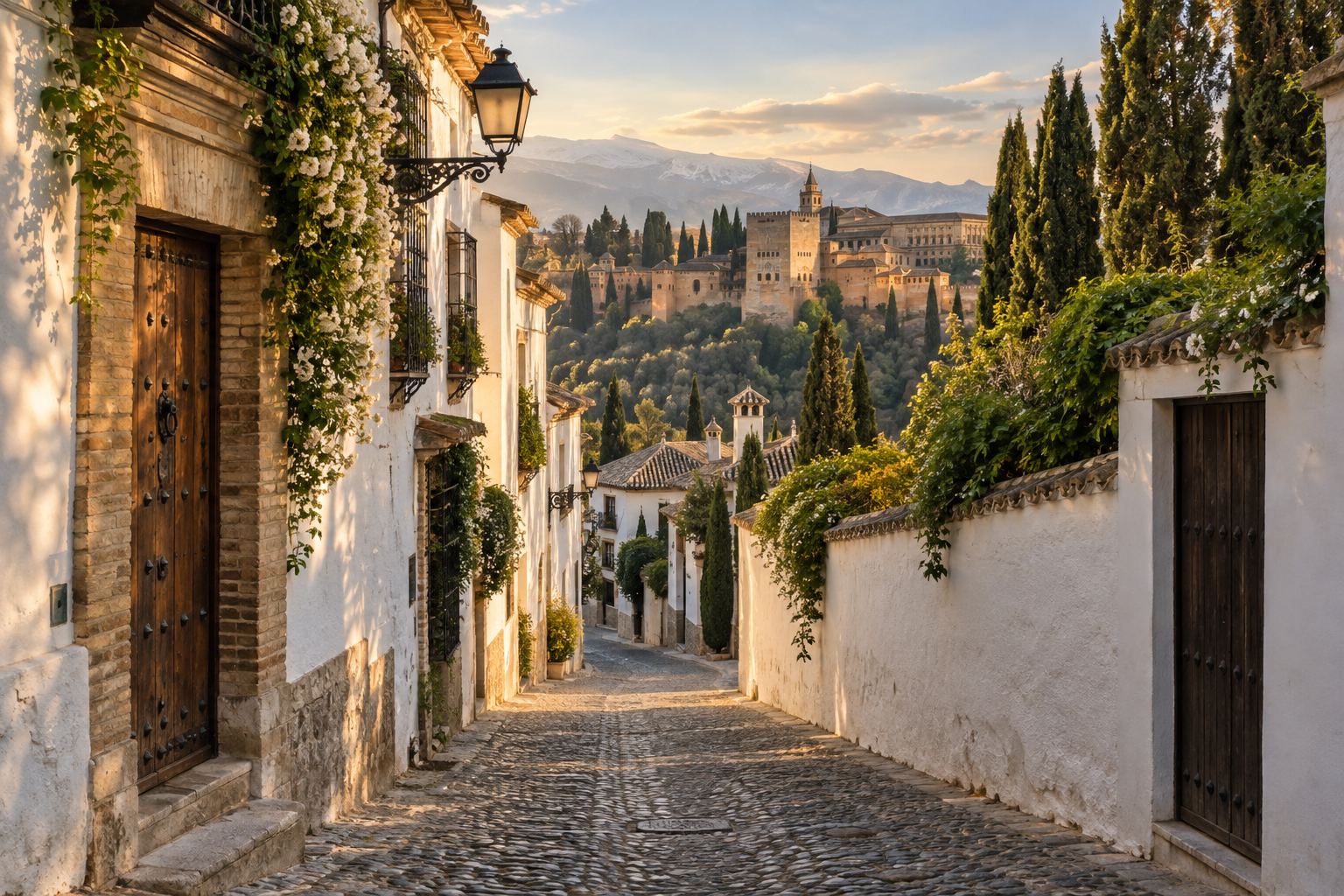
From across the Darro River, the Alhambra commands your attention. Yet some of Granada’s most revealing historical details lie on the opposite hillside, where the Albaicín climbs through narrow streets, small squares and enclosed gardens. Here, the story is less about a single palace than about the neighborhood surrounding you.
The Albaicín forms part of Granada’s UNESCO World Heritage property alongside the Alhambra and Generalife. Its importance rests not simply on individual monuments, but on the survival of an urban landscape shaped during the city’s Islamic centuries and transformed after the Christian conquest of 1492.
Look beyond the whitewashed walls. A church may occupy the site of a mosque. A modest stone opening may belong to a communal cistern. Behind an unassuming doorway, a courtyard may preserve the proportions of a medieval home.
A fluent and knowledgeable English-speaking driver can introduce this historical context during your journey to Granada and coordinate a practical arrival point near the old quarter. Once there, the narrowest lanes are best explored on foot, at a pace that allows you to notice what the larger monuments can overshadow.
Along the Darro: Water, Baths and a Palace View
Begin near Plaza Nueva and follow the Carrera del Darro, where the river runs below stone walls and the Alhambra rises above the opposite bank. The setting is beautiful, but the water also helps explain how Granada functioned. Rivers, channels and reservoirs sustained households, gardens and public buildings throughout the historic city.
El Bañuelo, an Islamic bathhouse generally dated to the 11th century, offers a particularly tangible connection to everyday life. Its sequence of rooms and star-shaped openings in the vaults make the building memorable even without elaborate decoration.
Bathhouses served practical and social purposes, while cleanliness also held religious significance. Standing inside, you can imagine the contrast between the enclosed bathing rooms and the busy streets outside. The building’s survival is especially valuable because many comparable structures disappeared or were substantially altered after the conquest.
Farther along, the Paseo de los Tristes opens the view toward the Alhambra. Its popular name, associated with funeral processions that once passed through this area on their way toward the cemetery, gives a somber undertone to one of Granada’s most attractive public spaces.
Pause here before climbing. The river-level perspective makes the relationship between fortress, hillside neighborhood and valley unusually clear.
Inside a Nasrid Home at the Casa de Zafra
The Alhambra tells you about royal ambition. The Casa de Zafra brings the scale back to domestic life. This surviving Nasrid house, now used to interpret the Albaicín, helps explain how a prosperous household could create privacy and comfort within a dense neighborhood.
Its courtyard is the key. Rather than opening broadly to the street, the house turns inward. Rooms face a central space where light, air and water become part of the architecture. The contrast between a restrained exterior and a carefully arranged interior is one of the most useful ideas to carry through the quarter.
As you continue walking, notice:
- Doorways that reveal little about the size of the building behind them.
- Walls that follow irregular streets rather than a formal grid.
- Brief views into planted courtyards, where public access is permitted.
Not every old doorway conceals a medieval house, and many buildings have changed repeatedly. That layered character is precisely the point. The Albaicín is not a reconstruction of one historical moment. It is a neighborhood where successive generations adapted older spaces to new needs.
Check current visitor arrangements before planning your walk around the Casa de Zafra or other small monuments, since access conditions can change.
Let us take you there, privately
Your own Mercedes-Benz and fluent English-speaking driver, on your schedule.
Request a private quoteCisterns and Gardens: The Neighborhood’s Water Story
Higher on the hill, the Albaicín’s historic cisterns reveal a less theatrical but essential side of its heritage. Known locally as aljibes, these reservoirs supported daily life in a neighborhood where collecting and distributing water required careful planning.
The Acequia de Aynadamar brought water from the area of Fuente Grande at Alfacar toward Granada. Its supply helped sustain the Albaicín, linking the crowded hillside to a much wider landscape beyond the city.
Look for the Aljibe del Rey, associated with the quarter’s historic water network. Even when interior access is unavailable, seeking out these structures changes how you understand the streets. Their small visible entrances give little indication of the storage spaces beneath them.
Water also helps explain the carmen, a distinctive Granadan property combining a house with an enclosed garden, sometimes including productive planting. The word has Arabic roots associated with vineyards, although the gardens you see today reflect centuries of change rather than an untouched medieval tradition.
High walls protect these private spaces. Over them, cypress trees, climbing plants and fruit trees soften the architecture. You do not need access to a private garden to appreciate the pattern: dense lanes outside, cultivated refuge within.
Mosque Sites, Church Towers and the Memory of 1492
The Christian conquest changed Granada’s political and religious life profoundly. In the Albaicín, that transformation remains visible in buildings that occupy older religious sites or incorporate earlier fabric.
At the Church of San José, the surviving minaret of an earlier mosque became a bell tower. It is a striking example of architectural continuity across a major historical rupture. The structure endured, while its religious setting and use changed.
San Salvador tells another part of the story. The church occupies the site of the Albaicín’s former congregational mosque and preserves elements of its courtyard. Such places invite a more thoughtful reading than a simple sequence of architectural styles.
The transition after 1492 was not merely decorative. Initial promises of religious protection gave way to coercion, forced conversion and persecution. The Muslim population and later Morisco communities experienced profound disruption, with further upheaval and expulsions during the 16th and early 17th centuries.
Carry that knowledge into the quieter lanes. The beauty of the quarter is real, but so are the histories of displacement embedded within it. Noticing both makes your visit richer and more honest.
Finish Above the City, Without Rushing the Hill
The Mirador de San Nicolás offers the classic relationship between the Albaicín and the Alhambra: palace walls across the valley, wooded slopes below and the Sierra Nevada beyond. It is popular for good reason, although a quieter moment often allows more time to study the landscape.
For a broader sense of the hillside, continue toward the upper quarter and the historic walls near the Puerta de las Pesas. This medieval gateway recalls the Albaicín’s defensive boundaries and provides a useful contrast to the open panorama at San Nicolás.
Plan for uneven paving, sustained climbs and limited vehicle access. Comfortable shoes matter more here than a tightly packed checklist. In warmer weather, an early start and pauses in shaded squares make the walk more comfortable.
Your fluent and knowledgeable English-speaking driver can coordinate arrival and collection at suitable vehicle-accessible points, reducing unnecessary backtracking without suggesting that every monument can be reached by car.
Portugal Magik offers private day tours, multi-day private journeys and transfers in black Mercedes-Benz E-Class, V-Class and Sprinter vehicles. With a fluent and knowledgeable English-speaking driver handling the road journey and transport logistics, you can give Granada’s old quarter the attention it deserves: not just its famous silhouette, but the everyday histories still visible beneath it.
Let us take you there, privately
Your own Mercedes-Benz and fluent English-speaking driver, on your schedule.
Request a private quoteGood to know
Which part of Granada is best for exploring old neighborhood stories?
The Albaicín is particularly rewarding for its medieval street layout, historic houses, cisterns and religious buildings. Starting beside the Darro River and gradually climbing the hill reveals how these places relate to one another.
Can you explore the Albaicín entirely by private car?
No. Narrow lanes, steps and vehicle restrictions make walking essential for many areas. Private transport can simplify arrival and collection at suitable accessible points.
What should you wear for a walk through Granada’s old quarter?
Choose comfortable shoes with good grip for uneven paving and steep streets. Bring water and sun protection, particularly in warmer months, and allow time for rest stops.
Are the smaller historic monuments always open?
Visitor arrangements vary by monument and can change. Check current access and ticket requirements before building your route around places such as El Bañuelo or the Casa de Zafra.
Let us take you there, privately
Your own Mercedes-Benz and fluent English-speaking driver, on your schedule.
Request a private quoteSignature Journeys
Prefer a ready-made private itinerary?
See our signature journeys, starting from €2,950