A Roman City on Seville’s Doorstep
At Itálica, the scale of ancient Rome becomes tangible before you have read a single inscription. Broad streets cross open ground, mosaics mark rooms whose walls have largely disappeared, and an enormous amphitheater stands beyond the residential quarters. Near the modern town of Santiponce, northwest of Seville, these remains offer one of Andalusia’s most compelling encounters with the Roman world.
The setting is important. This was not an isolated outpost, but a city connected to the fertile Guadalquivir valley and the wider networks of Roman southern Spain. Today, the landscape feels open and quiet compared with central Seville. That contrast gives you room to consider the distance between the bustling city that once existed and the fragments that survive.
For a visit from Seville, a private English-speaking driver, fluent and knowledgeable, makes the journey straightforward, handling transport and sharing historical context along the way. Once you arrive, the archaeological site rewards an unhurried walk rather than a race between monuments.
From Republican Settlement to Imperial Prestige
Itálica’s origins are traditionally dated to 206 BC, when the Roman commander Publius Cornelius Scipio established a settlement here following his campaign against Carthaginian forces in Iberia. It became one of Rome’s earliest settlements in the peninsula, linking the region to a political world that would reshape its towns, agriculture and infrastructure.
Its greatest fame comes from its imperial connections. Trajan, who became emperor in AD 98, was born in Itálica. Hadrian’s family also had roots here, although his own birthplace is debated. These connections help explain why the city occupies such a prominent place in the story of Roman Hispania.
Under Hadrian, Itálica underwent a major expansion. Much of the archaeological area you visit today belongs to this enlarged district, often called the nova urbs, or new city. Its spacious layout, substantial houses and public buildings reflect civic ambition on an impressive scale.
This distinction matters when you look across the ruins. You are not seeing the entirety of ancient Itálica laid out before you. The older settlement lies largely beneath modern Santiponce, while the excavated expansion presents a particularly revealing chapter of the city’s development. What survives is both extensive and incomplete, a place where archaeology still shapes our understanding.
The Amphitheater: Architecture Built for Spectacle
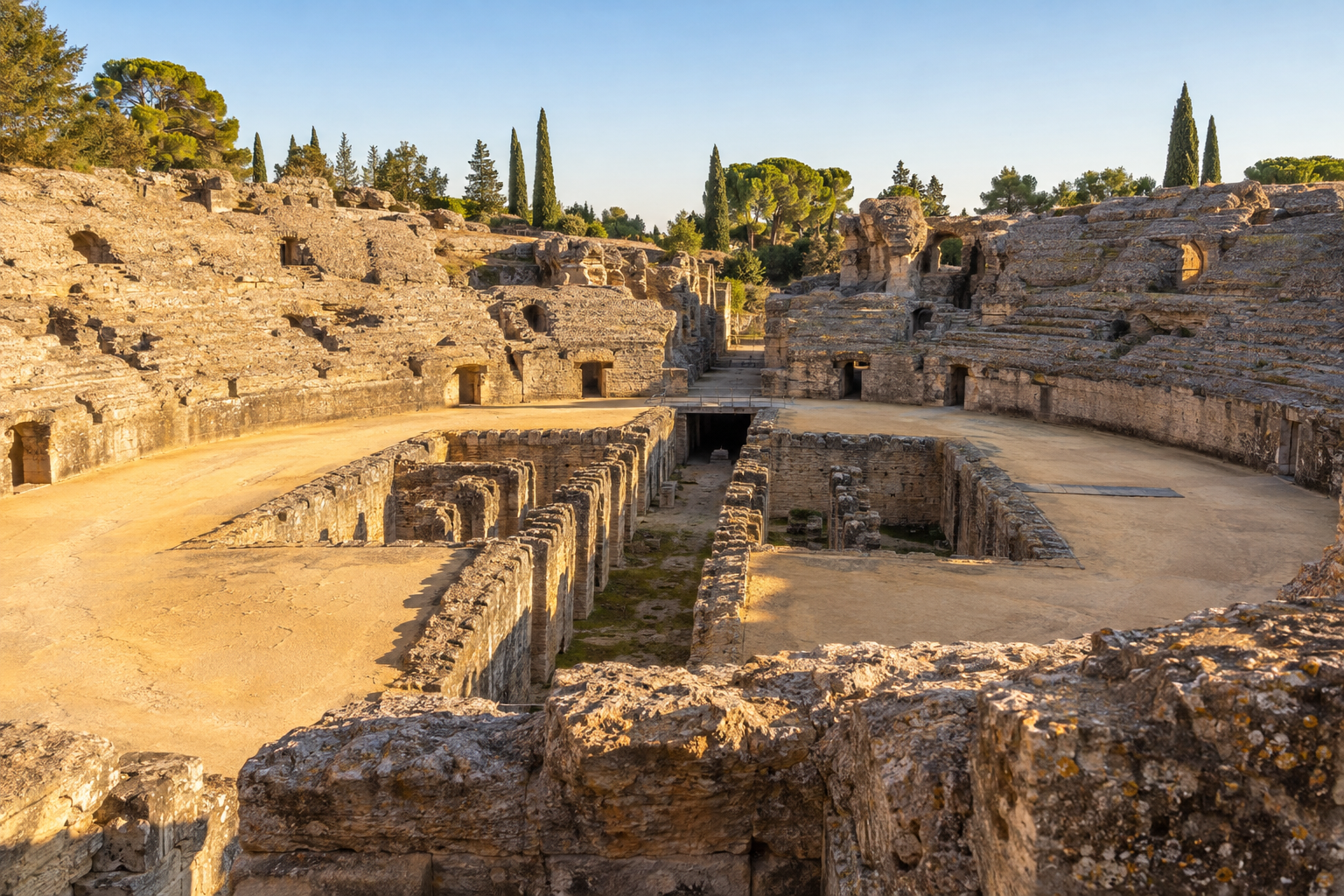
The amphitheater is Itálica’s most immediately dramatic monument. Its oval form, surviving passages and substantial masonry convey the engineering required to bring large crowds together for public spectacles. Even in its ruined state, the building feels distinct from the quieter domestic spaces nearby.
Rather than concentrating only on its size, look at how it worked. Entrances and corridors directed spectators toward their seating areas, while the arrangement of the stands reflected the social divisions of Roman life. The architecture managed movement as carefully as it framed the events below.
In the center, the exposed substructure beneath the former arena floor reveals part of the building’s backstage organization. The arena would not originally have looked like the open excavation you see today. Its vanished floor once concealed spaces associated with staging spectacles.
Gladiatorial combat and animal spectacles belonged to a culture of public entertainment that could be brutal. Keeping that reality in mind gives the monument more depth than treating it simply as an impressive backdrop.
Access to individual corridors and viewpoints can vary with conservation work and site conditions. Follow the designated route, and allow time to see the structure from more than one angle. Its proportions become clearer as you move between the exterior and the accessible interior spaces.
Let us take you there, privately
Your own Mercedes-Benz and fluent English-speaking driver, on your schedule.
Request a private quoteMosaics and the Texture of Everyday Life
Beyond the amphitheater, Itálica’s residential remains change the scale of the visit. Here, the interest lies in rooms, courtyards and decorative choices. The houses belonged to a prosperous urban environment, where architecture could express wealth, education and social standing.
The mosaics are among the site’s most memorable features. In the House of the Birds, a patterned floor contains numerous representations of birds, turning close observation into part of the pleasure of looking. The House of the Planetarium takes its modern name from a mosaic depicting divinities associated with the seven days of the week.
These names are archaeological labels, not the original addresses or household names. They offer convenient ways to identify buildings whose ancient owners are often unknown.
As you walk, notice more than the surviving pictures:
- Courtyards that brought light and air into domestic interiors.
- Doorways and room arrangements that shaped movement through a house.
- Street layouts that connected private residences with the wider city.
- Drainage infrastructure that reveals the practical demands of urban living.
The mosaics can be beautiful in isolation, but they become more meaningful when you imagine their position within a furnished, inhabited home. These were floors beneath daily activity, not pictures originally intended for museum walls.
Visibility and access may differ between houses, so approach the visit with a few priorities rather than a fixed checklist of every pavement.
Reading the Ruins Within Andalusia’s History
Itálica provides a valuable counterpoint to the Islamic and Christian monuments that dominate many journeys through Andalusia. Long before Seville’s great medieval and early modern buildings took shape, Roman urban life had established another set of traditions in the region.
The visible remains help you recognize those traditions: planned streets, public entertainment buildings, baths, engineered drainage and houses organized around interior spaces. Roman influence was not simply a matter of conquering territory. It involved creating and adapting the physical systems through which people lived.
At the same time, avoid imagining a perfectly preserved city awaiting discovery. Buildings were altered, materials were reused, and later settlement changed the landscape. The gaps are part of the history, not merely absences to overlook.
Santiponce adds another layer. The Roman theater belongs to the older urban area and is separate from the main archaeological circuit. Its access arrangements should be checked independently. The nearby Monastery of San Isidoro del Campo, founded in the early fourteenth century, offers a contrasting encounter with medieval religious architecture, subject to its own visiting arrangements.
Your private English-speaking driver, fluent and knowledgeable, can help coordinate these separate locations and explain their broader historical setting during the journey. That makes it easier to connect different periods without assuming every monument shares the same entrance or schedule.
Planning an Unhurried Visit From Seville
Itálica is particularly rewarding when you leave space for observation. Allow several hours if you enjoy archaeology, rather than treating the amphitheater as a brief stop. The distances between features, the open setting and the detail of the mosaics all favor a measured pace.
Much of the visit is outdoors. In warmer months, consider an earlier arrival when opening arrangements allow, and bring water, sun protection and comfortable shoes. Uneven surfaces and stretches of exposed ground deserve consideration if walking is difficult for anyone in your party. Check current accessibility information before making plans.
Opening schedules, admission conditions and access to particular monuments can change. Confirm these details close to your visit, especially if you hope to add the theater or monastery.
Portugal Magik offers private transport in black Mercedes-Benz E-Class, V-Class and Sprinter vehicles, according to your party and travel arrangements. A private English-speaking driver, fluent and knowledgeable, handles the road journey and practical logistics, leaving you free to focus on the place itself.
The most satisfying visit ends with more than photographs of Roman masonry. You leave with a clearer sense of how deeply southern Spain participated in the Roman world, and how much that world can still reveal through a street, a floor or the curve of an ancient arena.
Let us take you there, privately
Your own Mercedes-Benz and fluent English-speaking driver, on your schedule.
Request a private quoteGood to know
Where is Itálica?
Itálica is beside Santiponce, northwest of Seville in Andalusia. Its location makes it a practical archaeological visit from Seville.
What are the main attractions at Itálica?
The principal attractions include the Roman amphitheater, the streets of the expanded city and residential mosaics such as those in the House of the Birds and House of the Planetarium. Access to individual areas can vary.
Was Emperor Trajan born in Itálica?
Yes. Trajan was born in Itálica. Hadrian also had family roots in the city, although his own birthplace is debated.
How much time should you allow for Itálica?
Several hours allows for an unhurried look at the amphitheater, streets and residential remains. Allow additional time for separate visits in Santiponce, subject to current opening and access arrangements.
What should you bring to Itálica?
Bring comfortable walking shoes, water and sun protection. Much of the site is outdoors, and uneven surfaces can require care.
Let us take you there, privately
Your own Mercedes-Benz and fluent English-speaking driver, on your schedule.
Request a private quoteSignature Journeys
Prefer a ready-made private itinerary?
See our signature journeys, starting from €2,950