A Village Best Understood on Foot
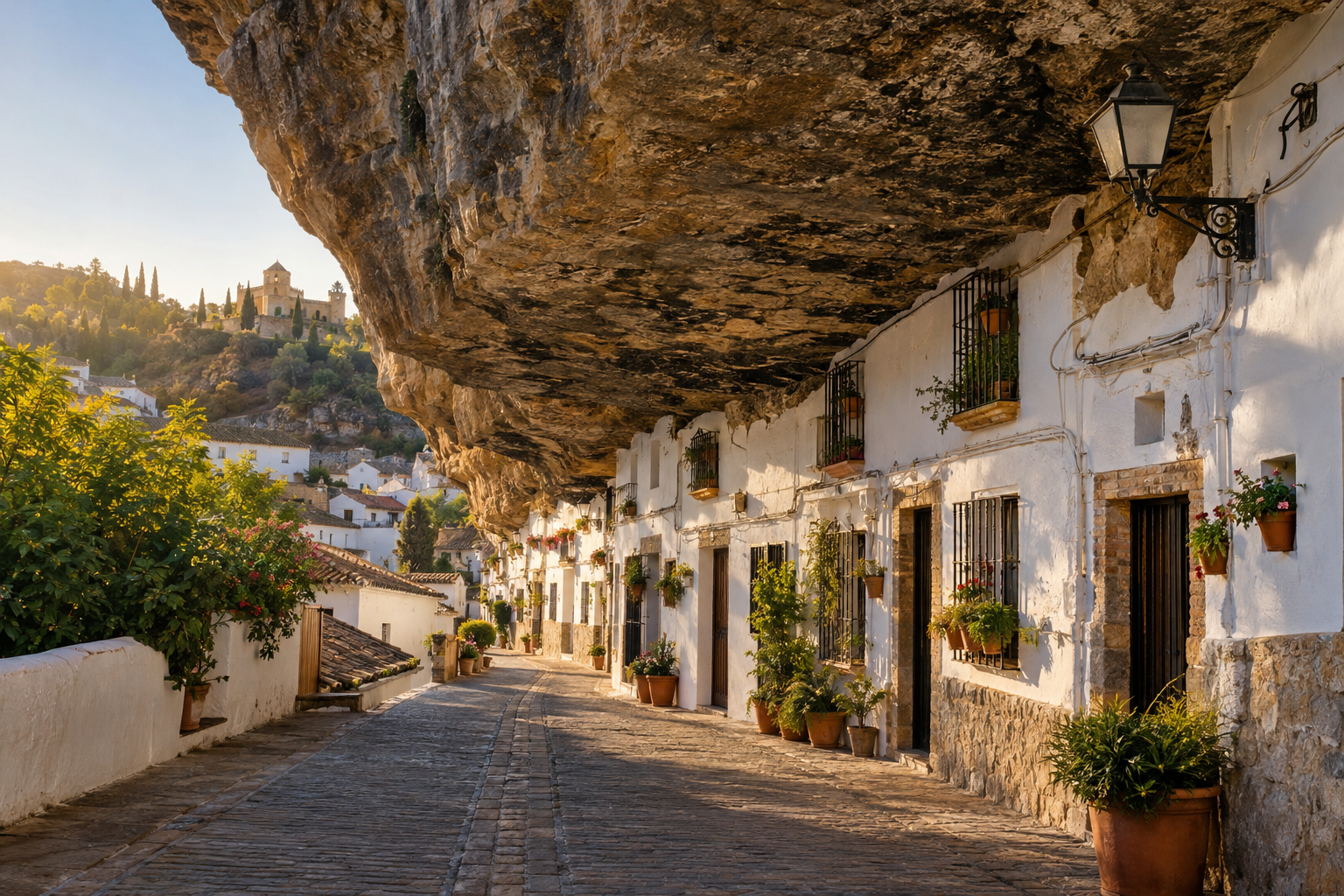
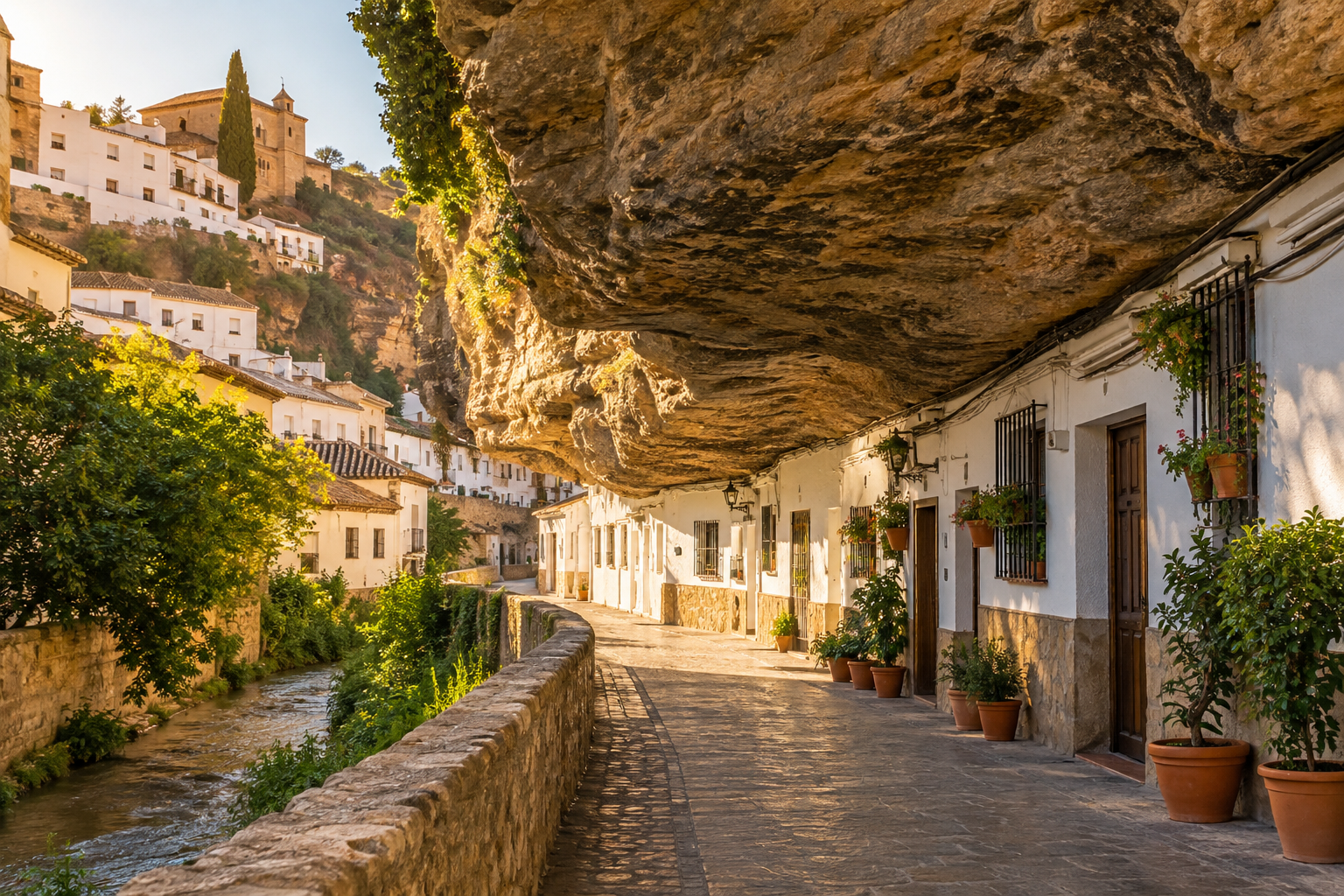
In Setenil de las Bodegas, the landscape does more than surround the village. It forms roofs, shapes streets and determines how you move between neighborhoods. Along the Río Trejo, houses sit beneath broad rock overhangs, while above them, whitewashed lanes climb toward the castle and the Church of Nuestra Señora de la Encarnación.
This village in Cádiz province rewards a walk organized around its different levels. The lower river streets offer the most immediate encounter with its unusual architecture. The upper historic quarter adds steep lanes, medieval remains and views that explain the setting more clearly than any single photograph.
Think of the areas below as walking quarters rather than formally defined neighborhoods. Each has its own character, and the transitions between them are part of the pleasure. Rather than rushing between famous corners, give yourself time to notice where a wall meets the rock, where daylight narrows and where the river reappears.
Arriving with a private English-speaking driver (fluent and knowledgeable) makes the practical side easier: you can agree on suitable drop-off and collection points without trying to park in the narrow historic streets.
Cuevas del Sol: Start Along the River
Calle Cuevas del Sol is the natural introduction to Setenil’s lower quarter. Here, a great shelf of rock extends over a row of whitewashed buildings beside the river. The street’s name refers to its sunnier aspect, although the light you find depends on the season and time of day.
The distinctive buildings are often described as cave houses, but that shorthand needs some explanation. Many make use of natural rock shelters, with masonry enclosing the space beneath an overhang. What makes the street remarkable is not simply that homes stand close to stone, but that the stone becomes part of their structure.
Walk slowly along the frontage and look upward. The irregular underside of the rock contrasts with the straight edges of doors and windows. Small changes in height and depth make each stretch different, even when the white walls seem uniform at first glance.
This is also one of Setenil’s busiest areas, with places to stop for refreshments. Enjoy the atmosphere, but keep doorways and the walking route clear. For a broader impression of the architecture, step back where space permits rather than trying to capture everything from directly beneath the overhang.
Cuevas de la Sombra: A Different Kind of Street
Nearby, Calle Cuevas de la Sombra offers a striking contrast. Along its most distinctive section, the rock spans overhead, creating an enclosed passage where the sky briefly disappears. Moving from the brighter riverside into this shaded space is one of the village’s most memorable transitions.
The attraction here is the relationship between scale and everyday life. An enormous mass of stone rests above an otherwise ordinary street of entrances and business fronts. Setenil’s unusual appearance comes from generations of adaptation to the terrain, rather than from a monument designed to stand apart from it.
Pause where you can do so without blocking others. Look toward the brighter openings at either end, then notice how the buildings fit beneath the uneven rock. Photographs looking outward often convey the setting better than a close view of the stone alone.
Explore the connecting lanes and river crossings as well. They help you understand how closely the two famous streets belong to the same landscape. This lower circuit is a useful first stage before deciding whether everyone in your party is comfortable with the climb into the upper village.
Let us take you there, privately
Your own Mercedes-Benz and fluent English-speaking driver, on your schedule.
Request a private quoteClimb Toward Plaza de Andalucía
Leaving the river behind changes the rhythm of your visit. The routes toward Plaza de Andalucía rise through a tighter arrangement of whitewashed buildings, with slopes, turns and occasional steps replacing the more direct riverside walk.
This central area deserves attention in its own right. It is the transition between Setenil’s heavily photographed rock streets and the higher historic settlement. As you climb, look back when the lane opens: roofs begin to overlap, and the depth of the river valley becomes more apparent.
Plaza de Andalucía provides a useful pause between the lower and upper quarters. From here, continue through the surrounding streets with an eye for simple architectural details: tiled roofs, ironwork, uneven building lines and the way houses occupy difficult ground.
Do not expect every lane to lead to a major attraction. Some of the most satisfying stretches simply reveal how the village works. These remain residential streets, so avoid stepping into private entrances and keep conversations considerate beside open windows.
For a gentler pace:
- Break the ascent into short stages rather than treating it as one continuous climb.
- Wear shoes with dependable grip on sloping paving.
- Carry water, particularly during warmer months.
- Turn back if the gradient is uncomfortable. The lower streets still offer a rewarding visit.
The Castle and Church Quarter Above
The upper historic quarter gives Setenil a different identity. Below, the defining image is domestic architecture beneath rock. Above, it is a fortified settlement occupying commanding ground.
The surviving castle tower recalls Setenil’s importance during the medieval frontier period. The town was captured by the forces of the Catholic Monarchs in 1484, during the campaign against the Nasrid kingdom of Granada. That history adds context to the elevated position and the defensive remains you see today.
Nearby stands the Church of Nuestra Señora de la Encarnación, whose late Gothic architecture reflects the Christian transformation of the settlement after the conquest. Together, the church and castle remains create a more monumental setting than the intimate streets beside the river.
Even if you do not enter either building, the surrounding lanes are worth exploring. Where the streets open out, you can appreciate the contrast between the compact village, the river-cut terrain and the countryside beyond. Interior access should be checked separately rather than assumed.
Your private English-speaking driver (fluent and knowledgeable) can share historical context during the journey to Setenil, leaving you free to concentrate on the streets and architecture once you arrive.
Shape the Walk Around Your Pace
A satisfying route begins with Cuevas del Sol and Cuevas de la Sombra, continues toward Plaza de Andalucía and then climbs to the castle and church quarter. Follow it as a flexible sequence, not a checklist. The village’s steep terrain means that a short distance on a map may take more effort than expected.
Earlier visits often provide a calmer setting for the famous lower streets, though Setenil can be busy on weekends and holidays. In hot weather, prioritize the climb before the warmest part of the day. After rain, take extra care on sloping surfaces and steps.
If you have limited mobility, discuss your needs before traveling. Setenil’s gradients and uneven routes make it important to plan around what is comfortable for you, rather than assume that the entire historic center will be accessible.
Portugal Magik can arrange private transport in a black Mercedes-Benz E-Class, V-Class or Sprinter, according to your party’s needs. A private English-speaking driver (fluent and knowledgeable) handles the driving and arrival logistics, particularly helpful when you combine Setenil with Ronda or another stop in Andalusia.
The best walk leaves time for both levels of the village: the extraordinary rock shelters below and the historic streets above. Together, they reveal a place shaped as much by daily life as by geology and conquest.
Let us take you there, privately
Your own Mercedes-Benz and fluent English-speaking driver, on your schedule.
Request a private quoteGood to know
Which areas of Setenil are best to explore on foot?
Start with Calle Cuevas del Sol and Calle Cuevas de la Sombra beside the river. Then, if you are comfortable with steep streets, continue toward Plaza de Andalucía and the upper castle and church quarter.
Is walking around Setenil physically demanding?
The climb from the river streets to the upper historic quarter involves slopes and some stepped routes. Wear shoes with good grip and adapt the walk to your mobility and the weather.
What is the difference between Cuevas del Sol and Cuevas de la Sombra?
Cuevas del Sol runs beneath a broad rock overhang beside the river. Along the most distinctive part of Cuevas de la Sombra, rock spans overhead, creating a more enclosed, shaded passage.
Can you combine Setenil with Ronda by private car?
Yes. Portugal Magik can arrange private transport connecting the two, with an itinerary that allows time for walking and accounts for your preferred pace.
Let us take you there, privately
Your own Mercedes-Benz and fluent English-speaking driver, on your schedule.
Request a private quoteSignature Journeys
Prefer a ready-made private itinerary?
See our signature journeys, starting from €2,950