A Peninsula With More Than One Past
Cádiz makes an immediate impression through light, sea and tightly packed streets. Yet its deeper interest lies in what those streets conceal. Beneath the buildings you see today are traces of earlier settlements, while towers above the rooftops recall a city whose fortunes depended on watching the Atlantic.
Founded by Phoenicians and known in antiquity as Gadir, Cádiz later became Roman Gades. Its geography has changed over the centuries through natural processes and human intervention. The ancient settlement occupied islands rather than precisely the peninsula you encounter today, an important distinction when imagining where early inhabitants lived and traded.
At the Gadir archaeological site, beneath the Teatro del Títere La Tía Norica, excavated structures and street surfaces bring that early settlement into focus. These remains offer something more intimate than a sweeping historical claim: evidence of people organizing homes, work and daily movement in a maritime community.
For you, this is a useful starting point. Cádiz is not simply a collection of monuments from different periods. It is a place repeatedly rebuilt over itself, where the oldest stories often sit below pavement level. Check current access arrangements before making an archaeological visit central to your day.
El Pópulo and the Roman City Beneath It
El Pópulo, the compact neighborhood beside the cathedral, preserves the close street pattern associated with the medieval city. Its historic gateways, including the Arco de la Rosa, Arco del Pópulo and Arco de los Blancos, help you picture an enclosed urban world rather than the open waterfront city of today.
These passages reward a slow approach. Notice how abruptly a narrow street opens into a small square, and how masonry from different periods sits together. Cádiz’s history is often easiest to understand through these changes in scale and material.
The Roman theater adds a much older chapter. Discovered in 1980, it belonged to ancient Gades and is associated with the ambitious building activity of the Balbus family in the first century BC. Parts of its curved seating and internal passage survive beneath and beside later buildings.
Its setting is part of the story. Rather than standing apart in a large archaeological landscape, the theater is embedded in the living quarter. That proximity makes the passage of centuries unusually tangible.
Nearby, the Church of Santa Cruz occupies the site of the old cathedral. Its comparatively restrained exterior provides a useful contrast with the monumental cathedral that eventually replaced it, reminding you that religious importance does not always announce itself through the largest facade.
Merchant Towers and a City Looking Outward
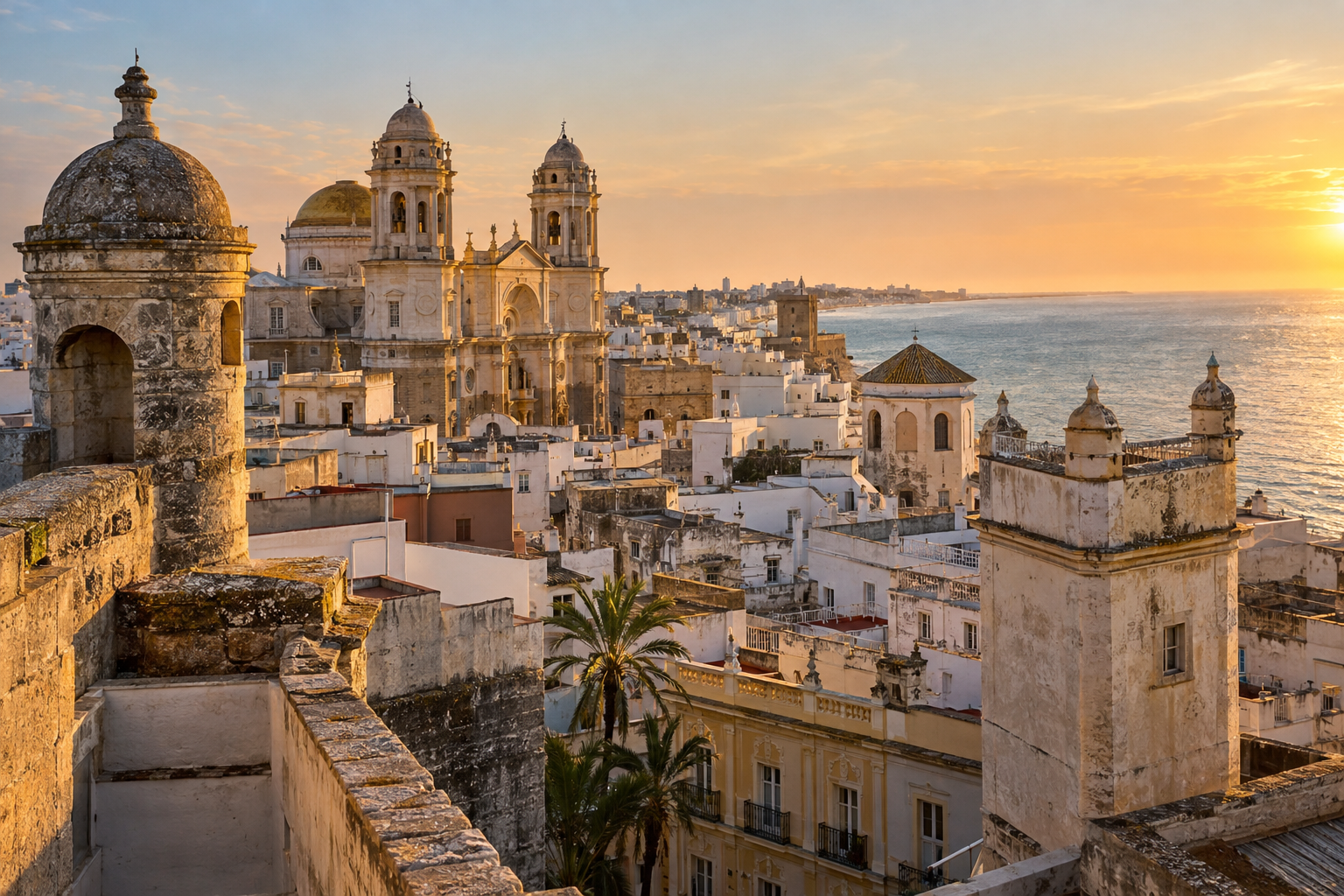
To understand Cádiz’s distinctive skyline, look above the balconies. The watchtowers rising from merchant houses were practical instruments of commerce, allowing observers to monitor shipping in the bay and approaches to the port.
The city’s Atlantic importance grew substantially through trade with Spain’s American territories. In 1717, the Casa de la Contratación, the institution overseeing that trade, moved from Seville to Cádiz. The transfer consolidated the position of a port already deeply involved in overseas commerce.
That prosperity was not an uncomplicated story. It belonged to an imperial trading system shaped by colonial extraction, unequal power and slavery. Remembering that context gives the grand houses more historical meaning than treating them solely as attractive architecture.
Torre Tavira is the best-known surviving watchtower. Its elevated perspective helps explain why merchants built upward: information arriving by sea had commercial value. If you choose to visit, check current admission arrangements and consider the stair climb before planning your day around it.
Around Plaza de San Antonio and Calle Ancha, substantial residences reflect the wealth and social ambitions of the trading city. Look for:
- Ornamental doorways that distinguish a merchant residence from its neighbors.
- Balconies positioned above narrow streets, combining visibility with domestic space.
- Upper-level towers that reveal the working purpose behind the elegant skyline.
A fluent and knowledgeable English-speaking driver can share the wider context of Cádiz’s Atlantic connections during your journey, leaving you free to concentrate on these details once you begin walking.
Let us take you there, privately
Your own Mercedes-Benz and fluent English-speaking driver, on your schedule.
Request a private quoteA Cathedral Built Across Changing Fortunes
Cádiz Cathedral is often photographed as a single, harmonious landmark, its dome prominent above the waterfront. Its construction history tells a more complicated story. Work began in 1722 and continued into the nineteenth century, spanning changes in architectural taste and the city’s economic circumstances.
The building combines Baroque and Neoclassical elements. Rather than trying to assign the entire cathedral to one style, look for the differences between its more theatrical forms and its restrained classical features. Those shifts reflect a project carried forward across generations.
Its position also matters. Close to the sea and near the older religious center, the cathedral expressed the confidence of an Atlantic commercial city. Seen from the waterfront, it becomes part of a broader composition of stone defenses, dense housing and open water.
Inside, the crypt holds the tombs of composer Manuel de Falla and writer José María Pemán. Falla’s presence offers a connection beyond maritime trade: Cádiz was also a birthplace of artistic lives whose influence reached far outside Andalusia.
Give the cathedral square time as well. Stepping away from the main facade helps you appreciate how such a large building meets the intimate streets around it.
The Streets Behind Spain’s 1812 Constitution
Cádiz’s old quarter also holds a story of political argument under wartime pressure. During the Peninsular War, the city resisted French siege while representatives debated the future of the Spanish monarchy and its territories.
The Constitution of 1812 was promulgated in Cádiz on March 19. Nicknamed La Pepa because that date is the feast of Saint Joseph, it became a major reference point in Spanish constitutional history, although its implementation was contested and short-lived.
The Oratorio de San Felipe Neri was the meeting place of the Cortes during the constitutional debates. Its importance lies in that transformation: a religious interior became a setting for discussions about sovereignty, representation and the limits of royal authority.
The nearby Museo de las Cortes offers further context. One of its notable objects is a historical model of Cádiz, which helps you read the city as a whole rather than as a succession of separate attractions.
Later, walk toward Plaza de España, where the Monument to the Constitution of 1812 presents a much grander public expression of this history. The contrast is revealing: debates took place within an enclosed interior, while their later commemoration occupies an expansive urban space.
La Viña, the Sea and a Thoughtful Walking Plan
Finish toward La Viña and La Caleta, where the relationship between neighborhood life and the sea feels particularly close. La Viña takes its name from land once used for vineyards; its later identity became strongly associated with fishing and popular traditions.
La Caleta sits between the defensive positions of Santa Catalina and San Sebastián. Their presence reminds you that the same sea bringing commerce also brought vulnerability. Looking across the beach, you can read leisure, work and coastal defense within one compact setting.
For a comfortable visit, connect El Pópulo, the merchant streets and the constitutional landmarks before continuing west. Add time for archaeological interiors rather than assuming every stop can be absorbed in a quick circuit.
Much of the old quarter is best explored on foot. A fluent and knowledgeable English-speaking driver makes arrival and departure easier by coordinating practical drop-off and collection points outside the tightest streets.
Portugal Magik can arrange a private day tour, multi-day journey or transfer in a black Mercedes-Benz E-Class, V-Class or Sprinter. With the road logistics handled, you can give Cádiz what its quieter stories deserve: time to look closely.
Let us take you there, privately
Your own Mercedes-Benz and fluent English-speaking driver, on your schedule.
Request a private quoteGood to know
Where can you see Cádiz’s earliest history?
The Gadir archaeological site preserves remains associated with the Phoenician settlement. In El Pópulo, the Roman theater reveals another important phase of the ancient city. Check current access arrangements before visiting.
Why do so many old houses in Cádiz have towers?
Merchant watchtowers allowed observers to monitor shipping. They reflect the importance of maritime information and Atlantic commerce to the city’s prosperity.
What connects Cádiz with Spain’s Constitution of 1812?
The Cortes met at the Oratorio de San Felipe Neri during the constitutional debates. The constitution was promulgated in Cádiz on March 19, 1812, and is commemorated by a major monument in Plaza de España.
Is Cádiz’s old quarter best visited on foot?
Yes. Its narrow streets and closely spaced landmarks suit walking. Private transport is useful for reaching Cádiz and coordinating arrival and departure, while comfortable shoes and a flexible pace help within the old quarter.
Let us take you there, privately
Your own Mercedes-Benz and fluent English-speaking driver, on your schedule.
Request a private quoteSignature Journeys
Prefer a ready-made private itinerary?
See our signature journeys, starting from €2,950