Begin Where Roman Andalusia Took Shape
Just outside Seville, beside the modern town of Santiponce, Itálica offers an unusually spacious encounter with the ancient world. Streets stretch between the foundations of substantial houses. Mosaic floors preserve fragments of domestic beauty. Beyond them, an amphitheater gives physical scale to the ambitions of a Roman city.
The site rewards a slow walk rather than a hurried circuit. Its history is not contained in one monument: it emerges through the relationship between public spectacle, private wealth, urban planning and the landscape around you.
For travelers staying in Seville, the journey is straightforward, but an unhurried arrival makes a difference. A private English-speaking driver (fluent and knowledgeable) can handle the journey and arrival logistics, sharing historical context along the way so that you reach the ruins with a clearer sense of what you are seeing.
Think of your visit as a walk through successive chapters, beginning well before the grand buildings that dominate the archaeological site today.
From a Military Settlement to an Imperial Connection
Itálica traces its foundation to 206 BC, when the Roman commander Publius Cornelius Scipio established a settlement here after the Battle of Ilipa. Ancient accounts associate its beginnings with soldiers recovering from wounds. The settlement became an important early Roman foothold in the Iberian Peninsula.
Its location belonged to the wider world of the lower Guadalquivir valley, a region whose agricultural resources and connections helped sustain Roman prosperity. Over time, what began in the context of military conquest developed into a community deeply integrated into Roman political and cultural life.
Itálica is especially associated with the emperor Trajan, who was born here and ruled from AD 98 to 117. His successor, Hadrian, also had strong family ties to the city. Although Hadrian’s birthplace is debated, the connection between his family and Itálica is well established.
Under Hadrian, the city received a major expansion. Much of the monumental residential district visible today belongs to that second-century development, often called the nova urbs, or new city.
That distinction helps you read the site correctly. You are not walking through a complete picture of Itálica at every stage of its existence. Much of the earlier settlement lies beneath modern Santiponce, while the open archaeological area reveals a particularly ambitious chapter in its urban history.
Read the City in Its Streets and Houses
One of Itálica’s most compelling features is its layout. The streets make the city intelligible even where buildings survive only at foundation level. You can follow the lines of movement, see how residential blocks were organized and imagine the transition from a public street into a private household.
Broad roads, drainage infrastructure and substantial houses speak of deliberate planning. Rather than concentrating only on individual objects, pause to consider the city as a working environment. Water had to arrive, wastewater had to leave, and households needed spaces for receiving visitors as well as everyday domestic life.
The larger residences also reveal how architecture expressed status. Courtyards brought light into interiors, while decorated rooms provided settings in which owners could display wealth and cultural sophistication.
As you walk, look for:
- The alignment of streets and the regular organization of building plots.
- Surviving stretches of paving and evidence of urban drainage.
- Courtyard arrangements within the larger houses.
- Differences between plain structural remains and richly decorated floors.
These details make the ruins feel less abstract. A threshold marks a real change between public and private space. A courtyard suggests how a house worked in the southern climate. A decorated room hints at the social expectations of its occupants.
Pause Over the Mosaics and Their Stories
The mosaics bring you closest to the tastes of Itálica’s prosperous residents. Their subjects range from animals to mythology, drawing on a visual language recognizable across the Roman world while remaining attached to particular homes and rooms.
The House of the Birds takes its modern name from a mosaic featuring a variety of birds arranged in separate compartments. Even without identifying every species, you can appreciate the care given to posture, color and pattern. Its appeal is immediate, but it also invites you to think about the expense and craftsmanship involved in furnishing an elite house.
The House of the Planetarium preserves another distinctive composition. Its mosaic depicts divinities associated with the seven days of the week, linking domestic decoration with Roman ideas about celestial bodies and time.
Elsewhere, the Neptune mosaic connects marine imagery with bathing culture. Such works are more than attractive survivors: they help explain how mythology, leisure and social display entered everyday surroundings.
Access to particular houses and mosaics can change with conservation needs. Allow the open areas to shape your route rather than expecting every named feature to be available. The pleasure lies in looking carefully, not in completing a checklist.
Let us take you there, privately
Your own Mercedes-Benz and fluent English-speaking driver, on your schedule.
Request a private quoteEnter the Amphitheater’s World of Public Spectacle
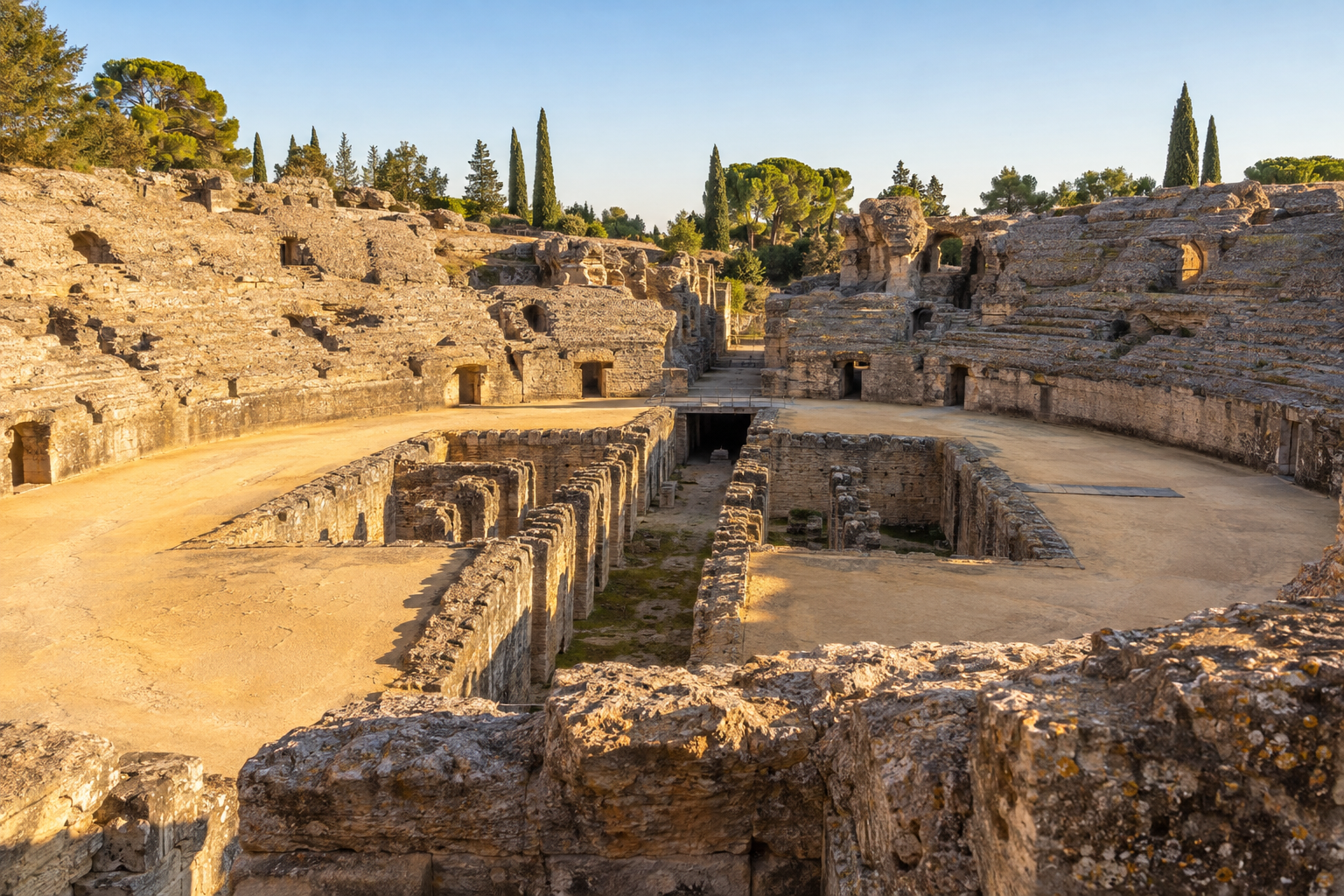
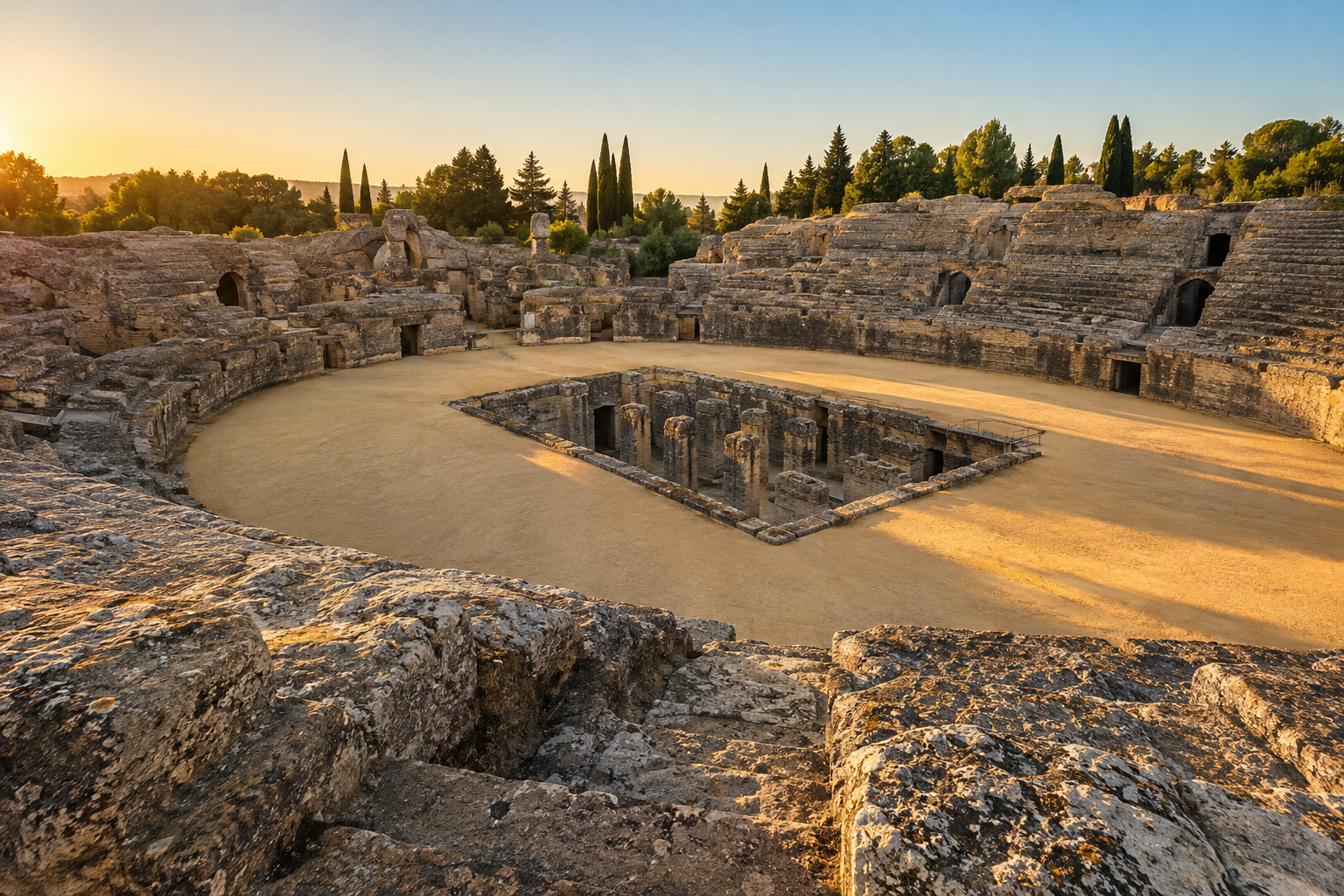
The amphitheater shifts the scale of your visit. After the intimacy of houses and mosaic floors, its massive remains evoke a place designed for crowds and collective attention.
Built during the city’s period of imperial expansion, it hosted spectacles associated with Roman public life, including gladiatorial combat and animal displays. Its size reflects ambitions extending beyond the needs of a modest local audience, suggesting Itálica’s importance within the surrounding region.
Approach slowly enough to notice how the building organized movement. Entrances and passageways carried spectators toward seating, while the arena focused their attention on the events below. Beneath the arena, a central service pit formed part of the infrastructure supporting the spectacles.
The surviving structure also makes Roman social hierarchy easier to imagine. Seating arrangements in amphitheaters reflected distinctions of rank and status. Public entertainment brought people together, but it did not erase the divisions between them.
There is a sobering side to this impressive architecture. The spectacle depended on violence, and the monument is best understood with that reality in view. Its engineering and atmosphere are remarkable without romanticizing what took place here.
Follow the Centuries Back Toward Santiponce
Itálica’s history did not end with its imperial flourishing. Parts of the expanded city declined over time, and later centuries brought changes in settlement, the reuse of building materials and, eventually, archaeological investigation and conservation.
The relationship with Santiponce remains essential. The Roman theater stands near the modern town, separate from the main walking circuit, reinforcing the point that ancient Itálica extends beyond the boundaries visitors first encounter. Access arrangements should be checked separately rather than assumed.
For another historical layer, consider the nearby Monastery of San Isidoro del Campo, founded in 1301. Its medieval architecture offers a striking contrast to the open Roman remains and broadens your understanding of this small area’s long significance. Check current access before including it in your plans.
For the archaeological site itself, comfortable shoes, sun protection and water matter. Much of the walk is outdoors, surfaces can be uneven, and summer heat can make an exposed visit tiring. Check current opening arrangements and favor cooler conditions when possible.
A private English-speaking driver (fluent and knowledgeable) makes it easier to coordinate Itálica with Santiponce or a return to Seville, without organizing your day around multiple transport connections.
Portugal Magik offers private day tours, multi-day private journeys and transfers in black Mercedes-Benz E-Class, V-Class and Sprinter vehicles. With an English-speaking driver (fluent and knowledgeable) handling the transport logistics, you can keep your attention on the place itself: the streets, the surviving floors and the centuries they reveal.
Let us take you there, privately
Your own Mercedes-Benz and fluent English-speaking driver, on your schedule.
Request a private quoteGood to know
Where is Itálica?
Itálica is beside Santiponce, just outside Seville in Andalusia. Its location makes it a practical historical outing from the city.
What are the main things to see at Itálica?
The principal attractions include the amphitheater, planned Roman streets, substantial house remains and mosaics such as those in the House of the Birds and House of the Planetarium. Access to individual areas can vary for conservation reasons.
What is Itálica’s connection to the Roman emperors?
Trajan was born in Itálica, and Hadrian had strong family connections to the city. The extensive second-century expansion visible at the site is associated with Hadrian’s reign.
What should you bring for a visit?
Wear comfortable shoes and bring water and sun protection. The site is largely outdoors with some uneven surfaces, so cooler conditions generally make walking more comfortable.
Let us take you there, privately
Your own Mercedes-Benz and fluent English-speaking driver, on your schedule.
Request a private quoteSignature Journeys
Prefer a ready-made private itinerary?
See our signature journeys, starting from €2,950