Start With Plaza de San Juan de Dios
Cádiz occupies a narrow peninsula on Andalusia’s Atlantic coast, and its monuments make more sense when you remember how closely the city has always depended on the sea. Phoenician settlement, Roman urban life and Atlantic trade each left their mark, although not always in immediately obvious ways.
Plaza de San Juan de Dios is an excellent place to begin. Opening toward the port, this elongated square introduces the relationship between maritime arrivals and civic authority. The Ayuntamiento, Cádiz’s city hall, anchors its inland end with a formal facade and clock tower.
Rather than treating the square as a passage toward the cathedral, pause to appreciate its proportions. The open space, palms and surrounding buildings offer a generous first impression before the streets become narrower. The adjacent Church of San Juan de Dios adds another layer to the square’s architectural character.
Arriving from Seville or Jerez, a private English-speaking driver (fluent and knowledgeable) makes the approach easier by handling the journey and arranging a practical drop-off near the historic center. From there, these first landmarks are best appreciated on foot.
Give the Cathedral and Its Square Proper Time
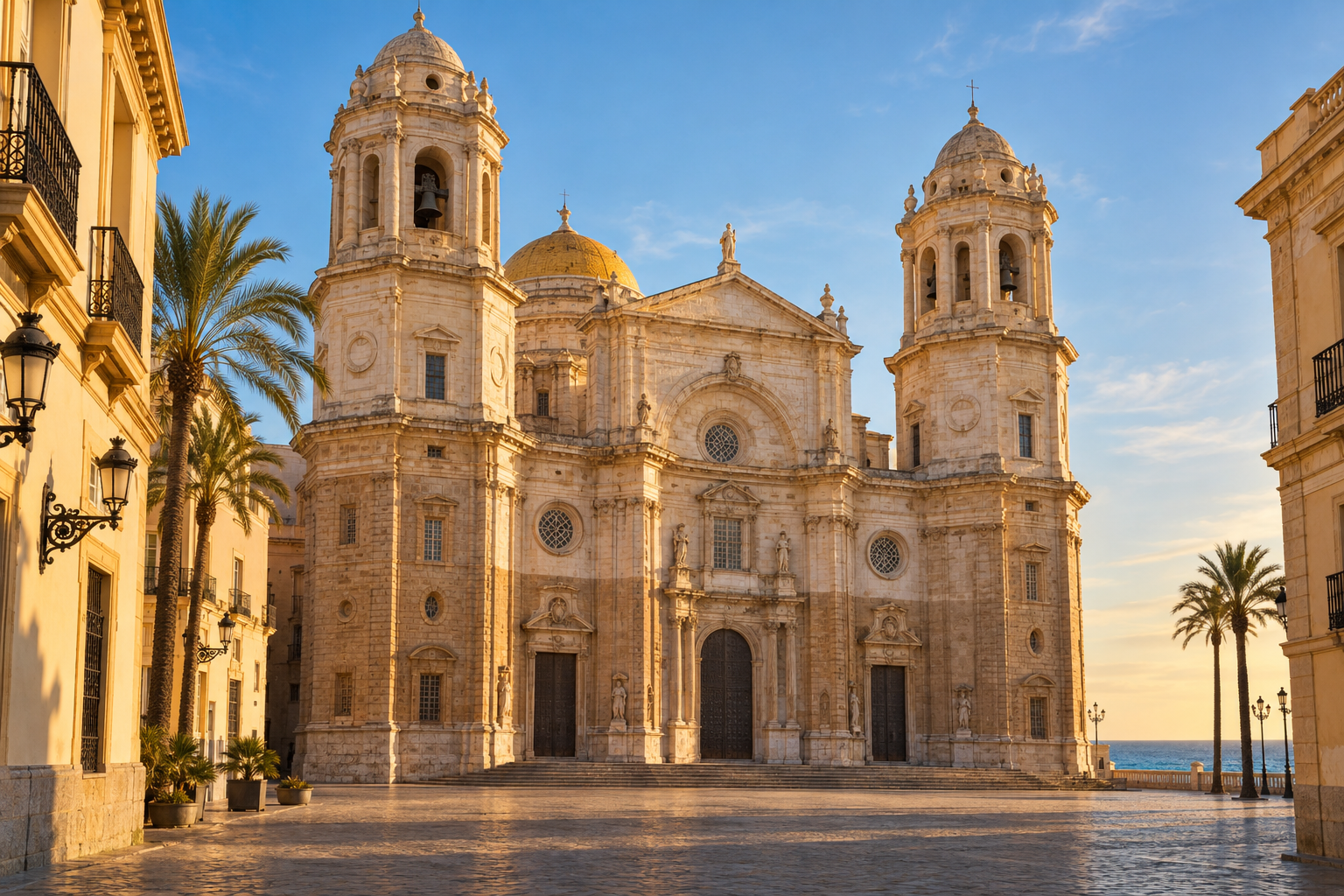
The cathedral is Cádiz’s most recognizable monumental building, its yellow-tiled dome rising above the roofs beside the Atlantic. Construction began in the eighteenth century and continued into the nineteenth, explaining the combination of Baroque and Neoclassical elements.
Its scale reflects the wealth and ambition associated with Cádiz’s importance in trade with the Americas. Viewed from Plaza de la Catedral, the facade feels especially imposing because the surrounding streets release you into the square quite suddenly.
Allow time for both the exterior and, when accessible, the interior. The broad nave and stonework offer a different impression from the sunny square. The crypt contains the tomb of composer Manuel de Falla, who was born in Cádiz.
If tower access is available and you are comfortable climbing stairs, the Torre de Poniente offers an elevated perspective over the city and sea. Check current admission arrangements before making it central to your plans.
Nearby, Plaza de Fray Félix provides a quieter architectural counterpoint. Here stands the Church of Santa Cruz, commonly known as the old cathedral. Its history reaches back to the medieval Christian city, although the building has undergone substantial changes. Seeing both churches helps you understand that the great waterfront cathedral was a later addition to an already established religious center.
Let us take you there, privately
Your own Mercedes-Benz and fluent English-speaking driver, on your schedule.
Request a private quoteLook Beneath the City at the Roman Theater
A short walk from the cathedral brings you into El Pópulo, where the Roman theater reveals a much older Cádiz. The remains belong to ancient Gades, an important Roman city whose influence extended beyond this small peninsula.
The theater dates to the first century BC and is associated with the Balbus family, prominent figures in the city’s Roman history. Its rediscovery in 1980 exposed a substantial monument beneath later layers of urban development.
What makes the visit compelling is the contrast between scale and setting. Outside, you are among compact streets and closely packed buildings. Within the archaeological site, the surviving seating and vaulted passage suggest the ambition of a major public venue.
The interpretation area helps explain how the remains fit into the ancient city. Access conditions can change, so confirm arrangements rather than assuming the site will be available whenever you arrive.
El Pópulo also preserves reminders of the medieval enclosure in its historic arches. The Arco de la Rosa, near the cathedral, is particularly easy to include. Together, the theater and these gateways make this small district valuable for understanding Cádiz across several periods, not simply as an eighteenth-century port.
Compare Plaza de las Flores and Plaza de San Antonio
Not every worthwhile stop needs a monumental interior. Cádiz’s squares reveal differences in scale, purpose and atmosphere that you can miss if you focus only on its largest buildings.
Plaza de las Flores, formally Plaza de Topete, is a compact, lively space associated with flower stalls. Its appeal lies in the relationship between everyday activity and the surrounding architecture. The nearby main post office provides a distinctive backdrop, while the central market is only a short walk away.
Come here for a pause between monuments, rather than expecting a grand ceremonial square. It is a useful place to notice how the historic center continues to function as a lived-in city.
Plaza de San Antonio offers a striking contrast. Larger and more formal, it is framed by substantial houses and the twin-towered Church of San Antonio. Its spaciousness gives you room to study the facades and consider the prosperity that reshaped Cádiz during its great trading centuries.
For a well-balanced visit, these squares serve different purposes:
- Plaza de las Flores offers an intimate stop near the market.
- Plaza de San Antonio rewards a slower look at architecture.
- Both provide breathing space between more concentrated monument visits.
Read Cádiz’s Political History in Plaza de España
Plaza de España deserves your attention for the Monument to the Constitution of 1812. Its sculptural composition commemorates a defining episode in Spanish political history, when the Cortes meeting in Cádiz produced a constitution during the Peninsular War.
Known popularly as La Pepa, the constitution was proclaimed on March 19, the feast day of Saint Joseph. It became an important reference point in Spain’s constitutional history, even though its initial life was brief.
The monument is much later than the event it commemorates. Its figures, inscriptions and sweeping arrangement turn the square into a statement about citizenship, political authority and national memory. Walk around it rather than viewing it only from the front.
For a closer connection to the proceedings themselves, consider the Oratorio de San Felipe Neri, where the constitution was debated and approved. Its restrained exterior contrasts with the importance of what happened inside.
A private English-speaking driver (fluent and knowledgeable) can share historical context during the journey to Cádiz, helping you connect these constitutional landmarks with the city’s maritime wealth and wartime position before you arrive.
Finish With the Atlantic Fortifications
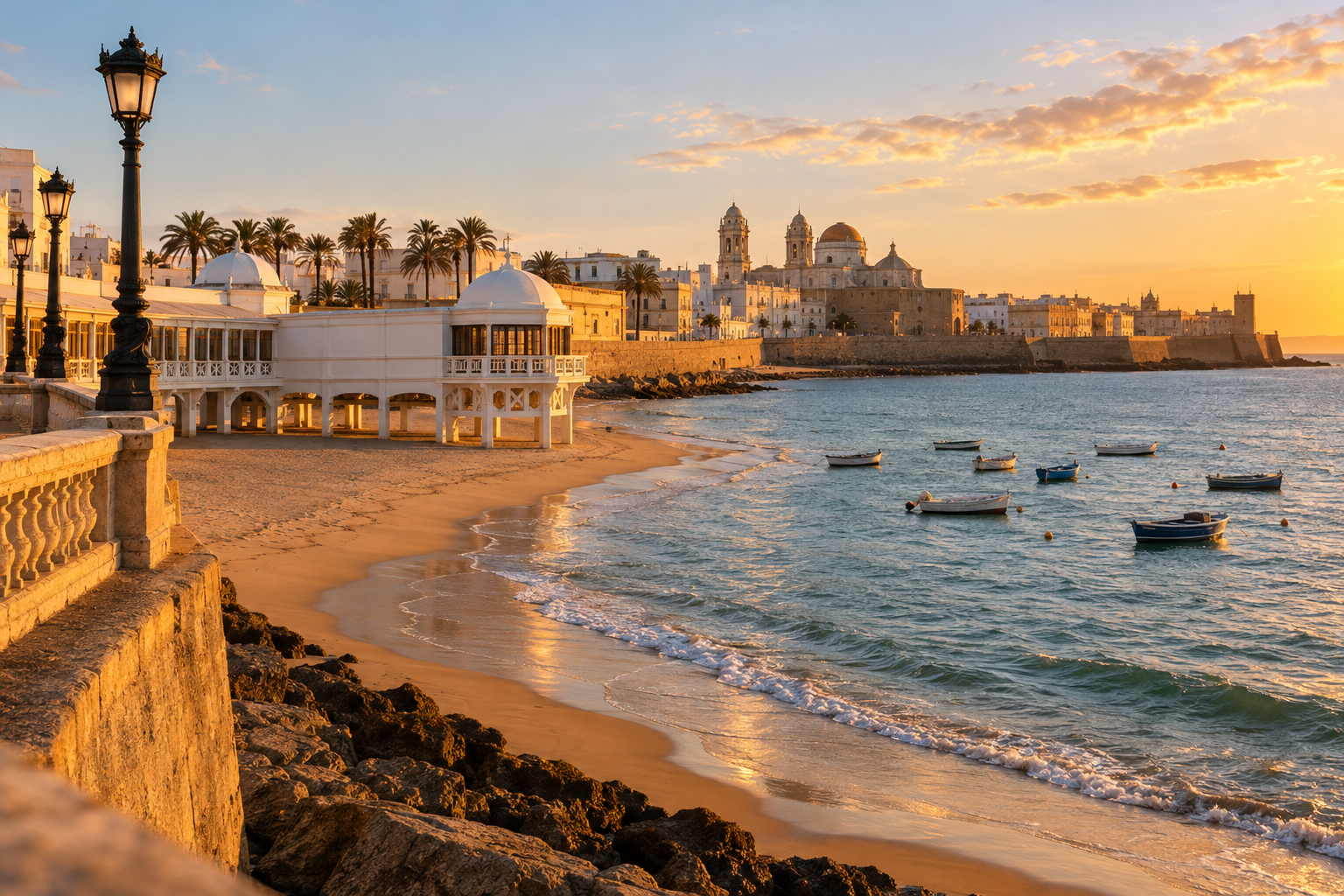
End your monument-focused visit by turning toward La Caleta and the defenses along the Atlantic edge. Here, Cádiz’s exposed geography becomes unmistakable. The sea brought commerce, but it also required protection.
The Castle of Santa Catalina, built following the Anglo-Dutch attack of 1596, occupies one side of La Caleta. Its angular defensive design and coastal position offer a clear contrast with the cathedral and civic squares. Interior access may vary, but the surrounding setting is worthwhile in its own right.
Across the water, the Castle of San Sebastián stands beyond a long causeway. Even without entering the fortress, the view toward it helps explain the city’s defensive relationship with the ocean. Wind and sea conditions should shape how far you walk.
For a day visit, prioritize the cathedral area, the Roman theater, two contrasting squares and one coastal finish. A private English-speaking driver (fluent and knowledgeable) can coordinate your collection at a practical meeting point, reducing unnecessary retracing before your onward journey.
Portugal Magik arranges private day tours, multi-day private journeys and airport or city transfers in black Mercedes-Benz E-Class, V-Class and Sprinter vehicles. You choose the landmarks that matter most, while we handle the driving and transport logistics.
Let us take you there, privately
Your own Mercedes-Benz and fluent English-speaking driver, on your schedule.
Request a private quoteGood to know
Which monuments should you prioritize on a first visit to Cádiz?
Start with Cádiz Cathedral and the Roman theater, then add the Monument to the Constitution of 1812 in Plaza de España. Finish near La Caleta for views of the coastal fortifications.
Which Cádiz squares are most worth visiting?
Plaza de San Juan de Dios introduces the city’s civic architecture, while Plaza de la Catedral frames its best-known monument. Plaza de las Flores, Plaza de San Antonio and Plaza de España each offer a different perspective on local life and history.
Can you see Cádiz’s main monuments in one day?
You can enjoy a thoughtful selection in one day, especially if you limit interior visits and group nearby stops. Admission arrangements, walking pace and time spent at the waterfront will determine how much you comfortably include.
Is the historic center best explored on foot?
Many central monuments and squares are close together and best appreciated on foot. Private transport is useful for reaching Cádiz and continuing your journey, with drop-off and collection arranged where vehicle access permits.
Let us take you there, privately
Your own Mercedes-Benz and fluent English-speaking driver, on your schedule.
Request a private quoteSignature Journeys
Prefer a ready-made private itinerary?
See our signature journeys, starting from €2,950