A Coastal City Best Discovered at Walking Pace
Cádiz occupies a narrow peninsula on Andalusia’s Atlantic coast, with its old town gathered at the northern end. Water is rarely far away, even when tall façades and closely packed streets hide it from view. Turn a corner and a shaded lane can suddenly open onto a square filled with coastal light.
The city’s origins reach back to a Phoenician settlement, followed by Roman, medieval and Atlantic trading chapters. Those layers are not arranged neatly into separate districts. You encounter them together: an ancient theater behind everyday streets, medieval gateways beside cafés, and merchants’ lookout towers above residential rooftops.
For walking, four neighborhoods make particularly rewarding starting points: El Pópulo, Santa María, La Viña and El Mentidero. Treat their boundaries as useful orientation rather than rigid divisions. The pleasure lies in moving between them and noticing how the streets change.
If you are arriving from elsewhere in Andalusia, a private English-speaking driver (fluent and knowledgeable) can simplify the approach, arrange a practical drop-off outside restricted streets and share historical context during the journey. Once you arrive, walking is the best way to appreciate the old town’s smaller details.
El Pópulo: Gateways, Stone Arches and Roman Cádiz
Begin in El Pópulo, the compact medieval quarter between the cathedral area and the town hall. Its enclosed streets offer a striking contrast to the broad waterfront nearby. Here, passages narrow, stone arches frame your route, and buildings often reveal their age through a doorway or a fragment of masonry rather than a grand façade.
Three historic gateways help you understand the outline of the medieval town: the Arco del Pópulo, Arco de la Rosa and Arco de los Blancos. You need not follow a strict sequence. Walking between them gives you a sense of how small and defensible this part of Cádiz once was.
Look for the Roman theater, whose surviving remains recall the importance of ancient Gades. Its archaeological spaces deserve time if you choose to enter, but check current visitor arrangements rather than building your entire morning around assumed access.
The cathedral forms a monumental counterpoint to these intimate streets. Built over a lengthy period beginning in the eighteenth century, it combines architectural influences and presents one of the city’s most recognizable silhouettes. Step back into its square to appreciate the façade, then continue toward the waterfront for a different perspective on its dome.
Nearby Plaza de San Juan de Dios opens the walk into a larger civic setting, with the town hall as its focal point. It is a useful place to pause before continuing into Santa María.
Santa María: An Older Residential Rhythm
Southeast of El Pópulo, Santa María feels less like a sequence of headline monuments and more like an established residential quarter. Its appeal comes from the relationship between modest streets, religious buildings and the everyday life unfolding around them.
The neighborhood has strong associations with the history of flamenco in Cádiz. That cultural identity is part of the setting, but there is no need to organize your visit around a performance. A quiet walk offers its own rewards: tiled details, wrought-iron balconies and glimpses through open entranceways.
Calle Santa María provides a natural thread through the area. The convent associated with the neighborhood’s name and the Church of Santo Domingo are important landmarks, although interior access should never be assumed. Their exteriors alone help explain the longstanding presence of religious institutions in this part of the city.
Continue toward Puertas de Tierra, the substantial defensive gateway separating the old town from the newer city. The shift in scale is instructive. After close residential lanes, the fortifications make Cádiz’s strategic position much easier to understand.
Santa María suits travelers who enjoy observing rather than collecting sights. Walk respectfully, keep voices low near homes, and remember that an attractive doorway may belong to a private residence.
Let us take you there, privately
Your own Mercedes-Benz and fluent English-speaking driver, on your schedule.
Request a private quoteLa Viña: Streets That Lead Toward La Caleta
On the western side of the old town, La Viña brings the Atlantic into the experience more directly. Historically associated with fishing, the neighborhood is also closely linked to Cádiz’s carnival culture. Its streets feel sociable and lived-in, with smaller squares and façades that reward an unhurried approach.
Calle Virgen de la Palma is a natural place to begin. The Church of Nuestra Señora de la Palma anchors the street, while the surrounding lanes invite short detours. Rather than searching for a single perfect route, work gradually toward the sea.
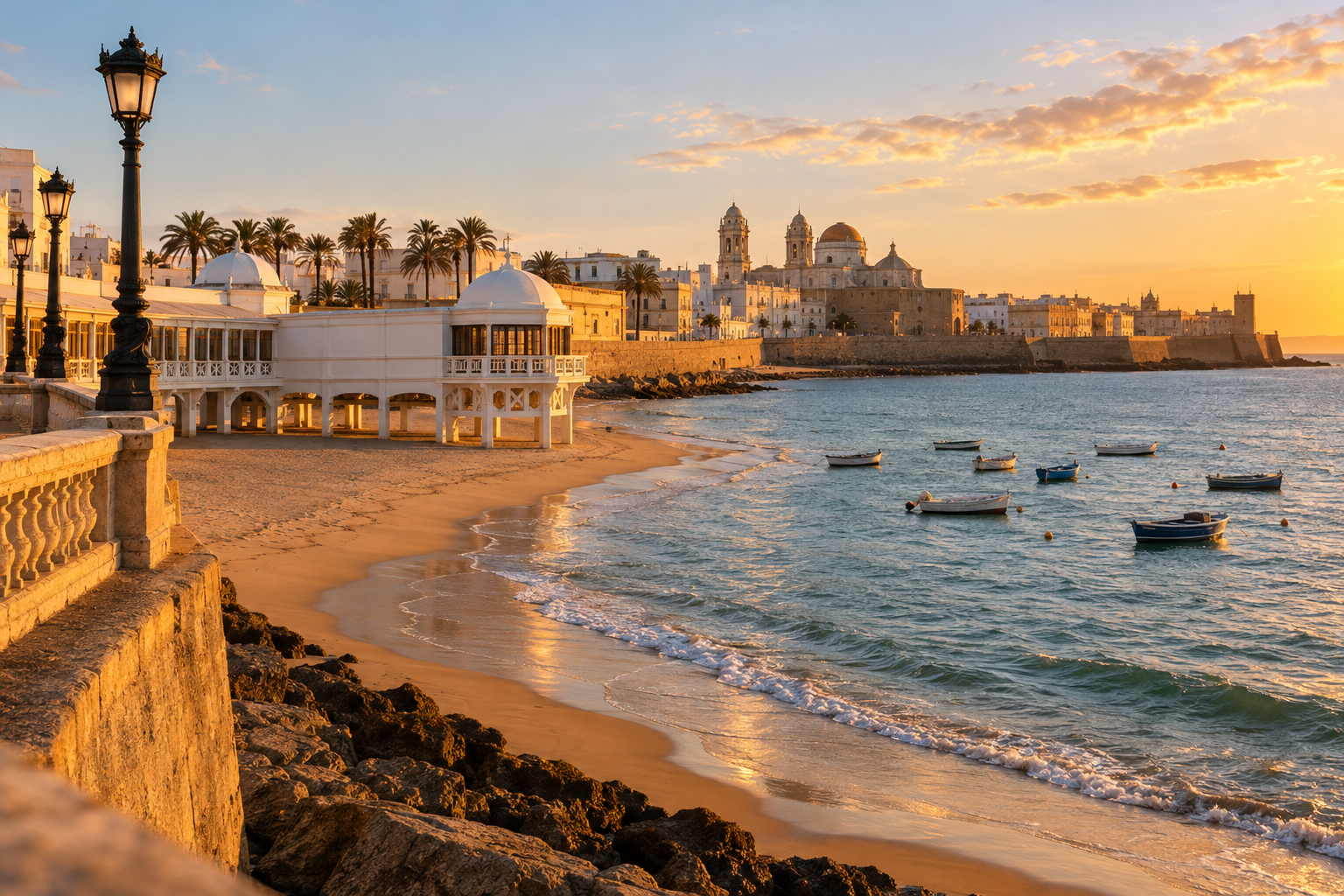
La Caleta is the neighborhood’s great outdoor destination. This small urban beach sits between the defensive landmarks of Santa Catalina and San Sebastián. Boats resting in the sheltered water, the curve of the shoreline and the pale former bathing pavilion create a scene quite different from Cádiz’s longer beaches outside the old town.
Take time to look in both directions. Santa Catalina stands beside the beach, while San Sebastián occupies an offshore position connected to land by a long causeway. Conditions and access can vary, so regard the causeway as an optional extension rather than an essential part of your walk.
Late afternoon often brings softer light to the western waterfront. It can also bring a noticeable breeze, making a light layer useful even after a warm walk through sheltered streets.
El Mentidero: Squares, Gardens and Atlantic Views
Turn north from La Caleta and the experience gradually becomes more open. El Mentidero offers a pleasing balance of neighborhood streets, public squares and access to the landscaped edges of the old town.
Plaza del Mentidero makes a comfortable pause, with space to sit and watch the district’s daily rhythm. Nearby, the Gran Teatro Falla provides an architectural highlight. Its red-brick exterior and horseshoe arches distinguish it from the pale stone and whitewashed surfaces seen elsewhere on your route.
Continue toward Parque Genovés for greenery and sea air. Its clipped trees, planted walks and shaded corners provide a welcome change after the enclosed streets of El Pópulo. The park is particularly useful when you want to slow the pace without abandoning the walk altogether.
Farther along the northern waterfront, the Alameda Apodaca offers planted promenades and views across the water. This stretch invites a different kind of attention: the pattern of paving, a ceramic detail, the shape of a mature tree, or light changing over the bay.
You do not need to complete every waterfront path. Choose a bench, enjoy the outlook and allow the city’s geography to settle into place.
Putting Your Neighborhood Walk Together
For a satisfying first visit, connect El Pópulo and Santa María in the morning, then continue to La Viña and El Mentidero as your energy allows. This is a substantial walk once you add monument visits and detours, so avoid treating it as a checklist.
A few practical choices make the day more comfortable:
- Wear supportive shoes for paving that can be uneven or polished smooth.
- Carry water and sun protection, especially along exposed waterfront stretches.
- Check current arrangements for any monument you hope to enter.
- Leave time for sitting in a square rather than walking continuously.
A private English-speaking driver (fluent and knowledgeable) can coordinate a collection point that suits your final neighborhood, saving you an unnecessary return across the old town. Vehicle access is limited in some streets, so a short walk to an accessible meeting place may still be needed.
Portugal Magik offers private day tours, multi-day private journeys and airport or city transfers in black Mercedes-Benz E-Class, V-Class and Sprinter vehicles. With a private English-speaking driver (fluent and knowledgeable) handling the road journey and logistics, you can give Cádiz the attention it deserves: on foot, at your own pace, with room for an unexpected turn.
Let us take you there, privately
Your own Mercedes-Benz and fluent English-speaking driver, on your schedule.
Request a private quoteGood to know
Which Cádiz neighborhoods are best for exploring on foot?
El Pópulo is ideal for medieval streets and ancient remains, Santa María for residential character, La Viña for access to La Caleta, and El Mentidero for squares, gardens and waterfront walks.
Can you explore Cádiz’s old town in one day?
You can enjoy several old-town neighborhoods in one day, but monument visits and waterfront detours add time. Choose a few priorities and leave space for breaks rather than trying to cover every street.
Can a private vehicle take you through every neighborhood?
No. Some old-town streets have restricted access or are unsuitable for vehicles. Portugal Magik can coordinate practical drop-off and collection points, with walking between the places you want to explore.
Let us take you there, privately
Your own Mercedes-Benz and fluent English-speaking driver, on your schedule.
Request a private quoteSignature Journeys
Prefer a ready-made private itinerary?
See our signature journeys, starting from €2,950