Start With the City’s Historical Layers
Córdoba rewards a first visit built around understanding rather than simply collecting sights. Beside the Guadalquivir River, you encounter a city shaped by Roman administration, the rulers of al-Andalus, medieval Jewish scholarship and the Christian monarchy. Its monuments do not belong to neatly separated chapters. Often, several histories occupy the same building.
Roman Córdoba was an important provincial capital. Under Muslim rule, the city became the seat of the Umayyad emirate and, in the tenth century, the caliphate of Córdoba. Following the Christian conquest in 1236, its religious and political landscape changed again, while much of its earlier architecture remained in use or was adapted.
For your first visit, concentrate on six connected places: the Mosque-Cathedral, Roman Bridge, Jewish Quarter and synagogue, Alcázar of the Christian Monarchs, and Medina Azahara. Together, they explain both the city beside the river and the ambitions that once extended beyond it.
Arriving from Seville, Málaga or elsewhere in Andalusia, a private English-speaking driver (fluent and knowledgeable) can share historical context during the journey and coordinate a practical arrival point near the old city. You should still expect to explore much of the historic center on foot.
The Mosque-Cathedral: Córdoba’s Defining Monument
The Mosque-Cathedral is the essential starting point because its architecture makes Córdoba’s changing history visible. Construction of the great mosque began under Abd al-Rahman I in the late eighth century. Successive rulers enlarged it, creating the vast interior that remains the city’s most recognizable landmark.
Inside, repeated rows of columns and red-and-white arches establish a striking visual rhythm. The double-tiered arches were an ingenious architectural solution, allowing greater height above relatively slender supports. Rather than treating the interior as a single photo opportunity, pause to notice how its scale and decoration change between different construction phases.
The tenth-century expansion under al-Hakam II contains some of the monument’s most refined work. Around the mihrab, rich mosaics and elaborate architectural forms express the wealth and authority of the caliphate. The mihrab marked the direction of prayer, although Córdoba’s mosque is notable for its unusually southerly orientation.
After the conquest of 1236, the building became a cathedral. The major cathedral choir and crossing inserted during the sixteenth century introduced a very different sense of space within the earlier mosque.
The key to understanding the building is to look at the relationship between these structures. It is both a major surviving monument of Islamic architecture and an active Catholic cathedral, not simply one building concealed inside another.
Allow generous time, check current visitor arrangements, and dress appropriately for a religious setting. The Patio de los Naranjos also deserves a pause, with its orderly planting and views toward the bell tower, which incorporates the earlier minaret.
Let us take you there, privately
Your own Mercedes-Benz and fluent English-speaking driver, on your schedule.
Request a private quoteThe Roman Bridge: Read the City From the River
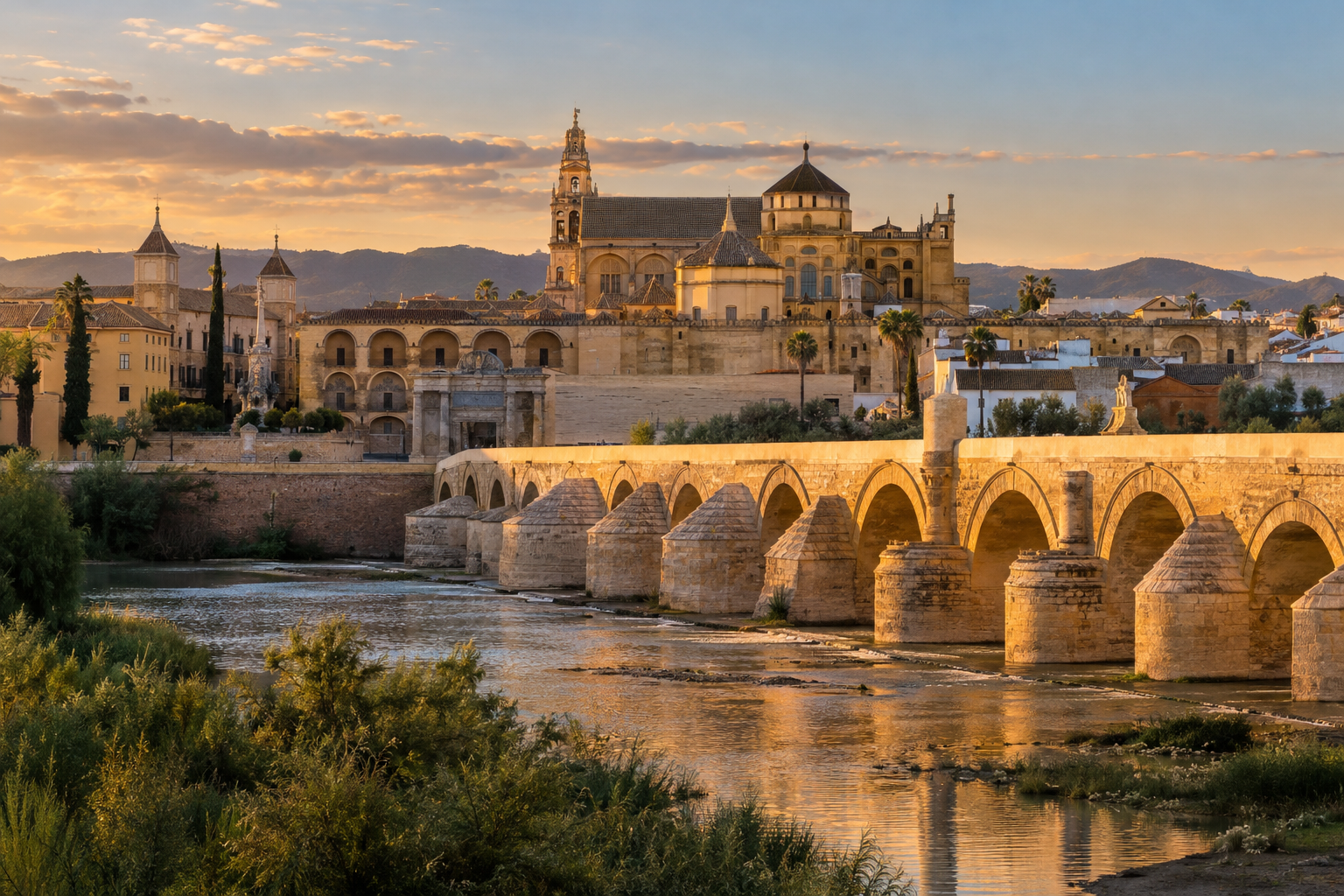
Walk toward the Guadalquivir after visiting the Mosque-Cathedral. From the river, Córdoba’s position becomes easier to understand: a substantial city controlling an important crossing, connected to roads, farmland and wider networks of trade.
The Roman Bridge has ancient origins, but its present appearance reflects many later repairs and alterations. Calling it Roman identifies its beginnings, not the date of every stone you see today. That distinction matters in Córdoba, where continuity often involved rebuilding rather than preserving a monument unchanged.
At the old-city end stands the Puerta del Puente, whose monumental Renaissance form belongs to a much later period. Across the river, the Calahorra Tower represents the defensive importance of the crossing, with medieval construction and subsequent changes shaping its appearance.
Cross the pedestrian bridge for a broad view back toward the Mosque-Cathedral. The river foreground helps you appreciate the monument’s scale within the surrounding city, something that narrow streets cannot convey.
Look downstream as well. The river around the Sotos de la Albolafia supports vegetation and birdlife, offering a quieter natural counterpoint to the stone monuments. It is a reminder that Córdoba’s history has always depended on a living landscape, not just its buildings.
The Jewish Quarter and Synagogue: Look Beyond the Street Names
West of the Mosque-Cathedral, the Jewish Quarter is best approached as a place of historical significance rather than simply a collection of picturesque lanes. Its streets preserve the memory of a community that contributed to Córdoba’s intellectual and commercial life, although the buildings you encounter reflect many periods.
The small synagogue, built in 1315, is especially important. It dates from Christian rule, not from the height of the Islamic caliphate. Its survival complicates any overly simple division of the city into separate religious eras.
Inside, decorative plasterwork and Hebrew inscriptions reward close attention. The architectural language reflects the Mudéjar tradition, in which forms associated with Islamic craftsmanship continued under Christian rule. Its modest scale offers an intimate contrast to the immense religious space nearby.
Córdoba was also the birthplace of the twelfth-century Jewish philosopher and physician Maimonides. His statue in the quarter commemorates that connection, but his life and work extended far beyond the city after his family left al-Andalus.
As you walk, avoid imagining medieval Córdoba as an uninterrupted age of harmony. Intellectual exchange existed alongside legal inequality, political upheaval and persecution. The Jewish expulsion from Spain in 1492 forms an essential part of this history. Understanding those tensions gives the quarter greater depth than its attractive streets alone can provide.
The Alcázar: Royal Power Behind the Walls
The Alcázar of the Christian Monarchs introduces another kind of authority. Developed under Alfonso XI in the fourteenth century on a site with earlier structures, it combines the character of a fortress with the spaces and symbolism of a royal residence.
Its association with Ferdinand and Isabella connects Córdoba to the final campaigns against the Nasrid kingdom of Granada. The site later served other purposes, including use by the Inquisition and as a prison. Its history is therefore broader, and sometimes darker, than its gardens initially suggest.
Notice the contrast between the substantial defensive walls and the open garden spaces. The pools, planting and paths you see today should not be mistaken for an untouched medieval garden. They form part of the monument’s later presentation and restoration history.
Roman mosaics displayed within the complex add another historical layer. They help explain how objects from ancient Córdoba have been recovered and interpreted within buildings from subsequent centuries.
Before visiting, check which interiors, towers and garden areas are accessible. Restoration or operational changes can affect the route. A private English-speaking driver (fluent and knowledgeable) can help coordinate your onward departure around your planned visits, while you retain time to explore the monuments at a comfortable pace.
Let us take you there, privately
Your own Mercedes-Benz and fluent English-speaking driver, on your schedule.
Request a private quoteMedina Azahara: The Caliphate Beyond Córdoba
For the fullest understanding of Córdoba, look beyond the historic center to Medina Azahara, also known as Madinat al-Zahra. This archaeological site lies west of the city, at the foot of the Sierra Morena.
Founded in the tenth century by Abd al-Rahman III, it was a palace city designed to express the authority of the newly proclaimed caliphate. Its terraced arrangement, ceremonial spaces and administrative buildings show that political ambition operated on an urban scale, not merely within a single palace.
Its flourishing was brief. The upheavals of the early eleventh century brought destruction and abandonment, leaving a very different legacy from the Mosque-Cathedral, which continued in religious use.
Visit with an archaeological mindset. You are reading excavated remains and reconstructed elements rather than entering a complete surviving residence. The site museum provides valuable context for understanding the layout and the objects recovered there.
For a thoughtful first visit:
- Give the Mosque-Cathedral priority rather than squeezing it between other stops.
- Link the river, Jewish Quarter and Alcázar geographically, while respecting individual admission arrangements.
- Treat Medina Azahara as a separate excursion, with time for its museum and outdoor terrain.
- Plan around summer heat, uneven surfaces and current access requirements.
With Portugal Magik, a private English-speaking driver (fluent and knowledgeable) can handle the road journey between Córdoba and Medina Azahara in a black Mercedes-Benz E-Class, V-Class or Sprinter, according to your party’s needs. Any required local access arrangements remain separate. Whether Córdoba is a private day tour or part of a multi-day journey, leaving room to understand these landmarks makes the visit more rewarding.
Good to know
Which Córdoba landmark should you visit first?
Start with the Mosque-Cathedral. Its Islamic architecture and later Christian additions provide the clearest introduction to the historical layers you will encounter elsewhere in Córdoba.
Can you see Córdoba’s main landmarks in one day?
A carefully planned day can cover the Mosque-Cathedral and several nearby landmarks, depending on admission arrangements and your walking pace. Adding Medina Azahara makes the schedule fuller, so an overnight stay allows a more relaxed visit.
Is the Roman Bridge entirely Roman?
No. The crossing has Roman origins, but the bridge has undergone numerous repairs and alterations. Its present structure reflects several periods of Córdoba’s history.
How does private transport help with a Córdoba visit?
Private transport simplifies travel from other Andalusian cities and the separate excursion to Medina Azahara. Much of Córdoba’s historic center is best explored on foot, with drop-off and collection coordinated around vehicle access restrictions.
Let us take you there, privately
Your own Mercedes-Benz and fluent English-speaking driver, on your schedule.
Request a private quoteSignature Journeys
Prefer a ready-made private itinerary?
See our signature journeys, starting from €2,950