Discover Córdoba One Neighborhood at a Time
Córdoba’s great monument, the Mosque-Cathedral, deserves its reputation. Yet the city becomes more interesting when you step beyond its immediate surroundings. Narrow streets open onto intimate squares, church towers rise above tiled roofs, and whitewashed walls give way to stone doorways and glimpses of planted courtyards.
Walking allows you to appreciate these changes at their natural pace. The historic center is extensive, so resist the temptation to treat every neighborhood as a stop on one continuous circuit. Choose two or three adjoining areas, leave room for a longer monument visit, and make the weather part of your planning.
If you are arriving from Seville, Málaga or elsewhere in Andalusia, a private English-speaking driver, fluent and knowledgeable, makes the approach easier by managing the journey and arranging a suitable drop-off near the historic center. Once you arrive, much of Córdoba’s appeal lies in leaving the car behind.
The Judería: Narrow Lanes Around a Great Monument
The Judería, Córdoba’s historic Jewish quarter, occupies the lanes northwest of the Mosque-Cathedral. Its compact streets invite slow exploration, though the most photographed corners can be busy. Arriving earlier in the day often gives you more space to appreciate the proportions of the buildings and the quiet turns between them.
Begin around Calle Judíos, where the medieval synagogue is an important reminder of the city’s Jewish history. Built in the early 14th century, it preserves decorative plasterwork and Hebrew inscriptions. Check current admission arrangements before making it a fixed point in your walk.
Nearby, the statue of Maimonides recalls the philosopher and physician born in Córdoba in the 12th century. His presence here offers a useful connection between the neighborhood’s physical streets and the intellectual life associated with the medieval city.
Continue toward Calleja de las Flores, just outside the quarter’s core. From its small end square, the narrow passage frames a celebrated view of the Mosque-Cathedral’s bell tower. It is a brief detour rather than a place to linger when crowded.
Allow a separate block of time for the Mosque-Cathedral itself. Its layered Islamic and Christian architecture deserves more attention than a quick stop between streets.
San Basilio: Courtyard Traditions Beside the Old Walls
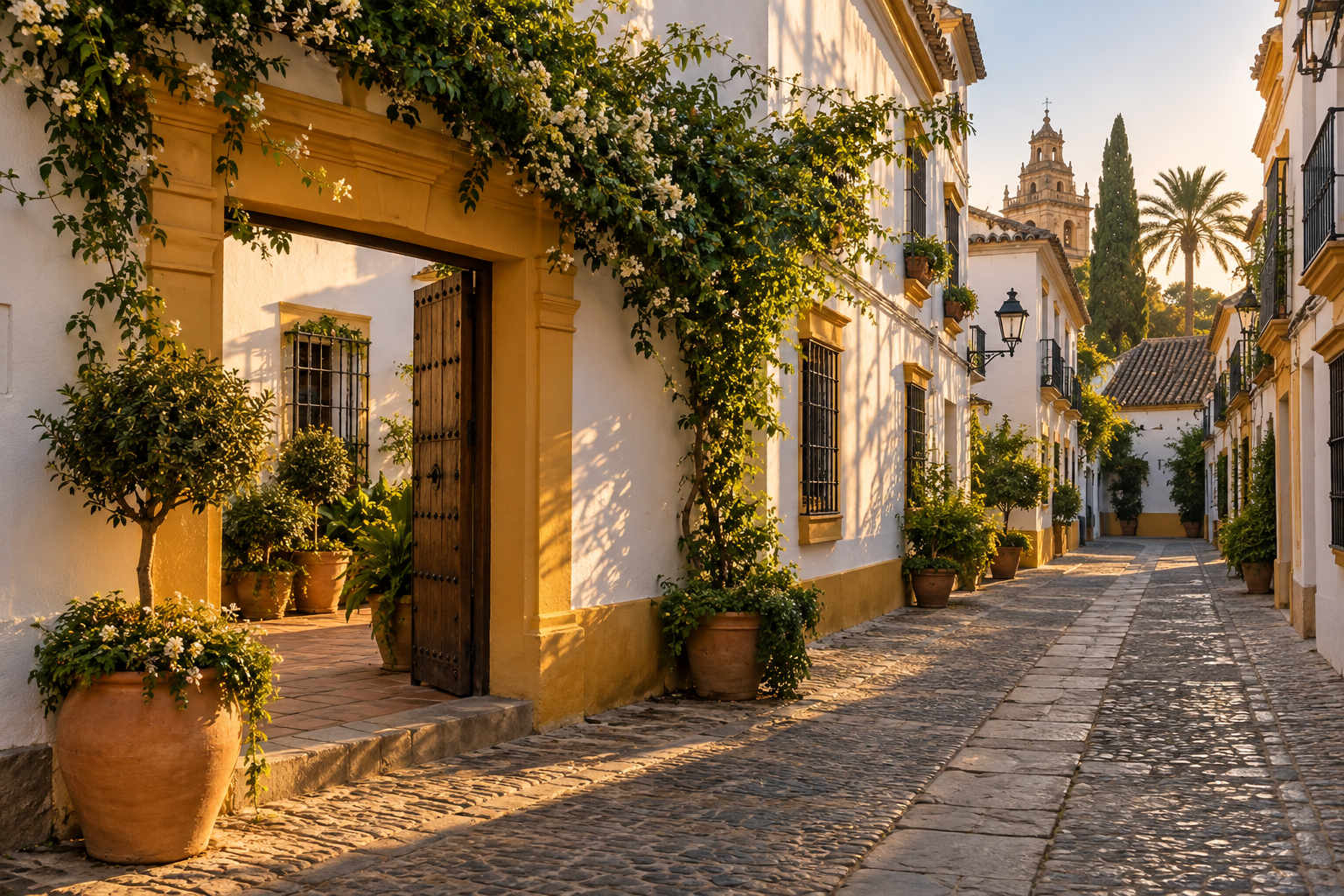
Southwest of the Mosque-Cathedral, San Basilio has a different rhythm. Also known as the Alcázar Viejo district, it is closely associated with Córdoba’s courtyard tradition. Low houses, white facades and modest street widths create a more residential atmosphere than the streets surrounding the principal monument.
Follow Calle San Basilio and explore the adjoining lanes. The pleasure is partly in the contrast between relatively restrained exteriors and the greenery sometimes visible beyond an open entrance. Courtyards remain lived-in spaces, and an open door should not be treated as permission to enter.
Córdoba’s annual courtyard festival brings particular attention to this area, but access varies by property and season. Outside festival dates, selected courtyards may have organized visiting arrangements. Verify those details rather than assuming every flower-filled patio is open to visitors.
Nearby stand the Alcázar de los Reyes Cristianos and surviving sections of the city’s defenses. If you include the Alcázar, its gardens and historic setting make a substantial addition to the walk. Check current access arrangements, especially if particular parts of the complex matter to you.
Let us take you there, privately
Your own Mercedes-Benz and fluent English-speaking driver, on your schedule.
Request a private quoteSan Pedro and La Magdalena: Squares Beyond the Busiest Lanes
East of the Mosque-Cathedral, the streets around San Pedro lead toward a less monument-dominated experience of Córdoba. You still encounter important historic buildings, but ordinary neighborhood life becomes more visible between them.
The Basilica of San Pedro belongs to the group of churches associated with the city’s transformation following the Christian conquest in 1236. Its exterior provides a strong architectural anchor for a walk through the surrounding streets. Interior access should be checked separately, since churches are places of worship rather than continuously open attractions.
Continue toward Plaza de la Corredera, a broad rectangular square enclosed by arcaded buildings. After the close streets of the old center, its scale feels striking. It is a natural place to pause and study the repeated balconies and long lines of the surrounding facades.
Farther east, La Magdalena offers another change of pace. Around its namesake church and square, Córdoba feels less concentrated around major visitor sights. Come for the street pattern, the architecture and the opportunity to spend time in a neighborhood rather than simply move between ticketed monuments.
Santa Marina: Córdoba’s Quieter Northern Streets
Santa Marina rewards visitors willing to walk farther north. Its defining landmark is the Church of Santa Marina de Aguas Santas, whose substantial stone exterior combines a fortress-like presence with medieval architectural detail.
The surrounding streets contain traditional houses, small squares and stretches where the city’s residential character takes precedence over sightseeing. This is a neighborhood for looking carefully: a carved doorway, an iron balcony, the relationship between a church facade and the space before it.
Plaza del Conde de Priego, near the church, contains a monument to the Córdoba-born bullfighter Manolete. Even if bullfighting is not your interest, the square helps explain the neighborhood’s associations and local identity.
The nearby Palacio de Viana makes a worthwhile addition if courtyards are central to your visit. Its sequence of patios offers a more structured encounter with courtyard architecture than glimpses from residential streets. Treat the palace as a separate visit, with its own admission arrangements and enough time to appreciate the differences between its spaces.
San Lorenzo: A Church Square and Residential Córdoba
East of Santa Marina, San Lorenzo is another rewarding area for travelers who enjoy church architecture and everyday streetscapes. The Church of San Lorenzo is distinguished by its rose window and arcaded entrance porch, features that give its setting a particularly recognizable character.
Spend time in the surrounding square before continuing along the neighboring streets. Unlike the lanes beside the Mosque-Cathedral, this area does not require a long list of must-see stops. Its appeal comes from the gradual accumulation of details and the quieter experience of walking beyond the main visitor circuit.
Santa Marina and San Lorenzo work well together as a northern neighborhood walk. Adding both after the Judería, San Basilio and several monument interiors, however, can turn a pleasurable day into a demanding one. Choose depth over coverage, especially in hot weather.
Plan a Walk That Suits the Season
Córdoba’s summer heat deserves serious consideration. Put your longest outdoor stretch earlier in the day, carry water and plan pauses rather than relying on shade throughout the route. Comfortable shoes also matter on uneven paving.
For a balanced visit, consider one of these combinations:
- A first visit: The Judería, the Mosque-Cathedral and San Basilio.
- Squares and local streets: San Pedro, Plaza de la Corredera and La Magdalena.
- Courtyards and churches: Palacio de Viana, Santa Marina and San Lorenzo.
A private English-speaking driver, fluent and knowledgeable, can share historical context during your journey and coordinate a practical pickup point, so you need not retrace the entire walk. Vehicle access is restricted in parts of the historic center, making that planning useful.
Portugal Magik offers private day tours, multi-day journeys and transfers in black Mercedes-Benz E-Class, V-Class and Sprinter vehicles. With a fluent, knowledgeable English-speaking driver handling the road journey and logistics, you can give Córdoba the attention it deserves on foot.
Let us take you there, privately
Your own Mercedes-Benz and fluent English-speaking driver, on your schedule.
Request a private quoteGood to know
Which Córdoba neighborhoods are best for a first visit?
Start with the Judería and San Basilio, allowing separate time for the Mosque-Cathedral. Together, they introduce Córdoba’s narrow historic streets, courtyard traditions and principal monumental setting.
Can you visit Córdoba’s residential courtyards year-round?
Some courtyards have visiting arrangements outside the annual courtyard festival, but access varies. Check individual properties and never assume that an open residential doorway permits entry.
Can you explore all these neighborhoods in one day?
You can cover considerable ground, but combining every neighborhood with monument interiors makes for a demanding day. Two or three adjoining areas usually allow a more relaxed visit.
How does a private transfer help with a walking visit to Córdoba?
It simplifies travel from another city and allows suitable drop-off and pickup points to be coordinated around your walk. Restricted vehicle access means you should still expect to explore the historic lanes on foot.
Let us take you there, privately
Your own Mercedes-Benz and fluent English-speaking driver, on your schedule.
Request a private quoteSignature Journeys
Prefer a ready-made private itinerary?
See our signature journeys, starting from €2,950