Begin in Málaga’s Historic Center
Málaga rewards a first visit that leaves room between its major sights. Set on Andalusia’s Mediterranean coast, the city has ancient origins, a substantial Moorish inheritance, and an elegant commercial center that opens toward the port. You can encounter several chapters of its history within a relatively compact area, without turning your day into a race between monuments.
Start around Calle Marqués de Larios, the pedestrian shopping street leading toward Plaza de la Constitución. Its handsome facades introduce the more polished side of Málaga, while the surrounding lanes draw you into a smaller-scale world of churches, squares, and old residential buildings.
For an initial walk, connect these places:
- Calle Marqués de Larios and Plaza de la Constitución for your bearings.
- The cathedral surroundings for monumental architecture and quieter side streets.
- Calle Alcazabilla for the Roman Theatre and the walls of the Alcazaba.
- Plaza de la Merced for a broad public square associated with Pablo Picasso’s early life.
Much of the central sightseeing area is best explored on foot. For your arrival or a day trip from elsewhere in Andalusia, a private English-speaking driver (fluent and knowledgeable) makes the approach easier by handling the road journey and arranging practical drop-off and collection points outside pedestrian streets.
See the Roman Theatre and the Alcazaba Together
Calle Alcazabilla offers one of Málaga’s most revealing views: the Roman Theatre below the Alcazaba, with the city’s later buildings close around them. Begin here if understanding the city’s history matters more to you than shopping or waterfront scenery.
The theatre dates to the early Roman imperial period and was rediscovered in the twentieth century. Its surviving seating and performance area make the ancient city easier to imagine. Even before entering any monument, the view from the street establishes the relationship between the archaeological remains and the fortified hillside above.
The Alcazaba, developed principally in the eleventh century, was both a defensive stronghold and a palatial complex. Its appeal lies in the progression through gateways, walls, courtyards, and gardens rather than in a single grand room. As you climb, the city appears through openings between stonework and vegetation.
Look for the contrast between the formidable outer defenses and the more intimate interior spaces. Water, planting, and sheltered courtyards help explain how a fortified residence could also offer comfort and refinement.
Allow unhurried time for the Alcazaba. Sloping paths, steps, and uneven surfaces make comfortable shoes important, and summer heat can turn a seemingly modest climb into a tiring one. Check current admission arrangements before visiting, and favor the cooler part of the day when possible.
Make Time for Gibralfaro’s Views
Above the Alcazaba stands the Castillo de Gibralfaro, whose surviving fortifications are closely associated with the Nasrid period. The castle protected the heights overlooking the lower fortress and the city’s port. Today, its strongest draw for a first-time visitor is the combination of defensive architecture and expansive views.
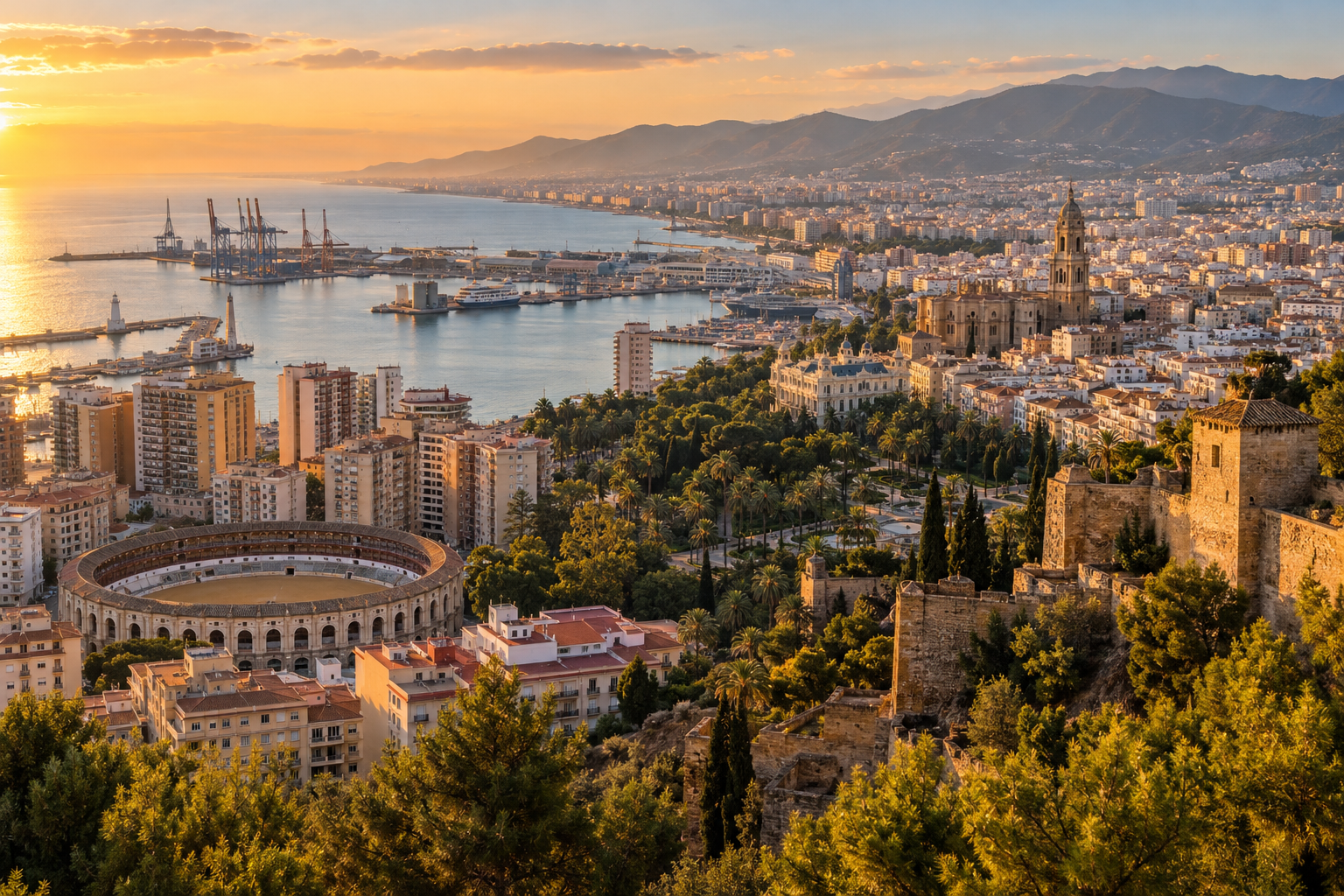
From the upper hillside and castle walls, Málaga becomes easier to read. You can trace the historic center, the harbor, the bullring, and the coastal development stretching beside the Mediterranean. This is a useful counterpoint to the enclosed streets below, especially if you enjoy photographing cities within their wider landscape.
Do not assume that seeing the Alcazaba means you have also visited Gibralfaro. They are separate attractions, and the uphill pedestrian approach to the castle can be demanding in warm weather. The historic fortified connection between them should not be treated as a public shortcut between the two visits.
A private English-speaking driver (fluent and knowledgeable) can take you by road toward the upper access area, reducing the climb from the city center. Walking and uneven surfaces remain part of the castle visit, but arranging the road transfer lets you reserve more energy for the walls and viewpoints.
Let us take you there, privately
Your own Mercedes-Benz and fluent English-speaking driver, on your schedule.
Request a private quoteChoose the Cathedral and One Picasso Stop
Málaga Cathedral deserves a place on a first itinerary even if you have already visited other great churches in Andalusia. Built over several centuries on the site of the former main mosque, it combines a predominantly Renaissance architectural character with later elements. Its unfinished southern tower gives the exterior its distinctive asymmetry.
Walk around the building before entering. The surrounding streets reveal different views of its scale, from broad facades to sudden glimpses between neighboring buildings. Inside, the height of the nave, chapels, and carved choir stalls reward a slower look. Check current visitor access, as religious services can affect sightseeing arrangements.
For art, Picasso offers a natural next chapter. He was born in Málaga in 1881, and two central institutions explore different aspects of that connection.
The Museo Picasso Málaga occupies the Palacio de Buenavista and presents work spanning different periods of his career. The building itself adds interest, bringing the museum into the architectural setting of the old town.
The Museo Casa Natal Picasso, at Plaza de la Merced, focuses on his birthplace and the context of his early life. It is a different visit, not another entrance to the same museum.
For a single day, choose according to your interests rather than automatically attempting both. The art museum suits a closer encounter with Picasso’s work; the birthplace adds biographical context. Leaving room afterward for the square and nearby streets often makes the day more satisfying.
Finish Beside the Port and Mediterranean
After stone walls, museum rooms, and narrow streets, Málaga’s waterfront gives you space and a change of pace. Walk through Parque de Málaga, the planted promenade between the city center and the port area, where palms and mature trees soften the transition from urban streets to the harbor.
Continue toward Muelle Uno, the waterfront shopping and restaurant area, and La Farola, Málaga’s historic lighthouse. This is a working port as well as a leisure district, so expect a maritime cityscape rather than an untouched seafront.
The Centre Pompidou Málaga, recognizable by its multicolored glass cube, provides another cultural option nearby. On a first visit, however, you need not add another museum simply because it is convenient. A walk beside the harbor may be exactly the balance your day needs.
If you want to reach the beach, continue toward La Malagueta. Its urban setting places the Mediterranean close to the city’s principal sights. You can enjoy the shoreline without planning a full beach day, particularly in the softer light toward evening.
Plan a First Day That Leaves You Breathing Room
For one full day, prioritize the Roman Theatre, the Alcazaba, the cathedral area, and a waterfront walk. Add either a Picasso museum or Gibralfaro according to whether art or panoramic views matters more to you. Attempting every major attraction can leave too little time to appreciate any of them.
With two days, separate the hilltop monuments from the museums and coastal walks. That also gives you flexibility around hot weather, admission availability, and the amount of walking you want to do.
Reserve relevant attraction tickets through official channels when appropriate, and check current opening arrangements shortly before your visit. Carry water, wear shoes with reliable grip, and remember that central pedestrian streets limit how close any vehicle can reach individual sights.
Portugal Magik offers private day tours, multi-day private journeys, and airport or city transfers in black Mercedes-Benz E-Class, V-Class, and Sprinter vehicles. Your private English-speaking driver (fluent and knowledgeable) shares history and context during the journey while handling transport logistics. For a first visit to Málaga, that means you can shape the day around the places you most want to see, with practical travel arrangements connecting them.
Let us take you there, privately
Your own Mercedes-Benz and fluent English-speaking driver, on your schedule.
Request a private quoteGood to know
What should you prioritize on a first visit to Málaga?
Start with the Roman Theatre, the Alcazaba, and the cathedral area, then finish with a waterfront walk. Add Gibralfaro for panoramic views or a Picasso museum if art is a priority.
Is Málaga’s historic center walkable?
Much of the historic center is compact and pedestrian-friendly. The Alcazaba involves slopes and steps, while the walk up to Gibralfaro is more demanding, especially in hot weather.
Are the Alcazaba and Gibralfaro the same attraction?
No. They are separate monuments with separate visitor access. Do not plan on using the historic fortified connection as a public route between them.
How long should you spend in Málaga on a first visit?
One full day gives you time for several central landmarks and the waterfront. Two days allow a more relaxed combination of museums, hilltop views, and coastal walks.
Let us take you there, privately
Your own Mercedes-Benz and fluent English-speaking driver, on your schedule.
Request a private quoteSignature Journeys
Prefer a ready-made private itinerary?
See our signature journeys, starting from €2,950